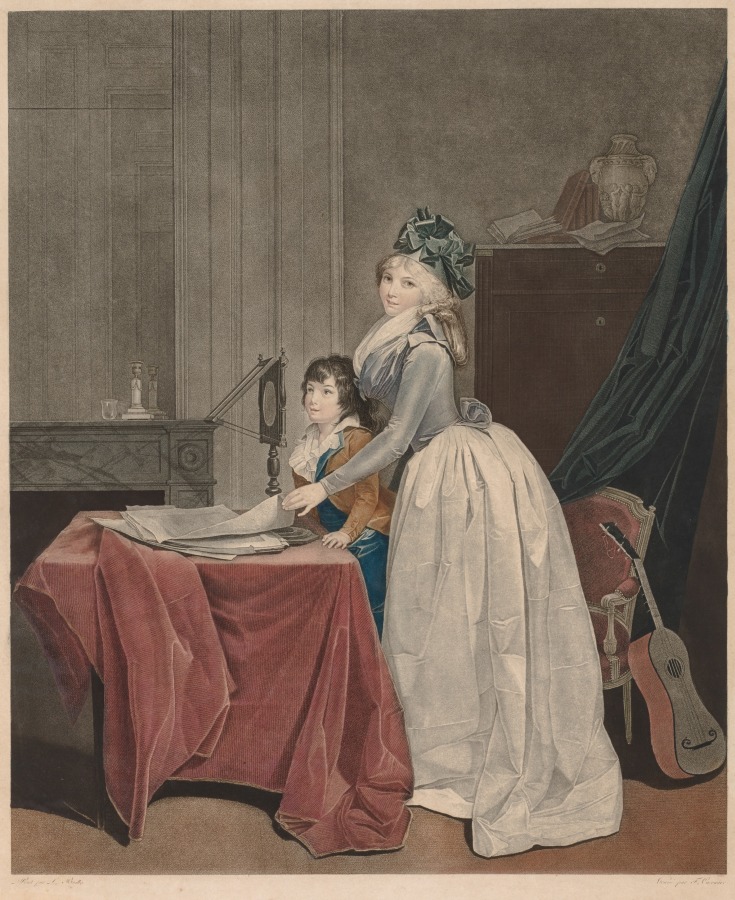
The Optical Viewer
Frédéric Cazenave · c. 1793 · Cleveland Museum of Art
Guide
Adjust the guideNew to it · Medium
Looking for this guide.
From the museum
In this print, a fashionable woman and a boy look at prints through an optical viewer known as a “zograscope.” This form of entertainment, popularized during the 1700s, was equipped with a concave lens that made images appear three-dimensionally. Special prints called vues d’optiques, or “perspective views,” were designed to enhance the sense of three-dimensionality, creating an immersive experience. Most of the scenes depicted cities or memorable occurrences, allowing the spectator to witness important sites and events from the comfort of their own home. Optical devices frequently appear in Louis Léopold Boilly’s work.
The museum’s own description, in English. Licence: CC0
What did you think?
Save this work’s image and museum information on this device to read without a connection.
Ask about this work
Ask in your own words. The answer comes from what the museum has written about the work, and says so when that does not hold it.
Details
- Maker
- Frédéric Cazenave (French, active 1793–1843), after Louis Léopold Boilly (French, 1761–1845)
- Date
- c. 1793
- Medium
- Chalk-manner etching and engraving
- Dimensions
- Image: 54.7 x 45.1 cm (21 9/16 x 17 3/4 in.); Platemark: 67.5 x 53.3 cm (26 9/16 x 21 in.); Sheet: 72.4 x 54.2 cm (28 1/2 x 21 5/16 in.)
- Place of origin
- France
- Held by
- Cleveland Museum of Art, Cleveland · Not on view
- Credit line
- John L. Severance Fund
Image: Cleveland Museum of Art, CC0