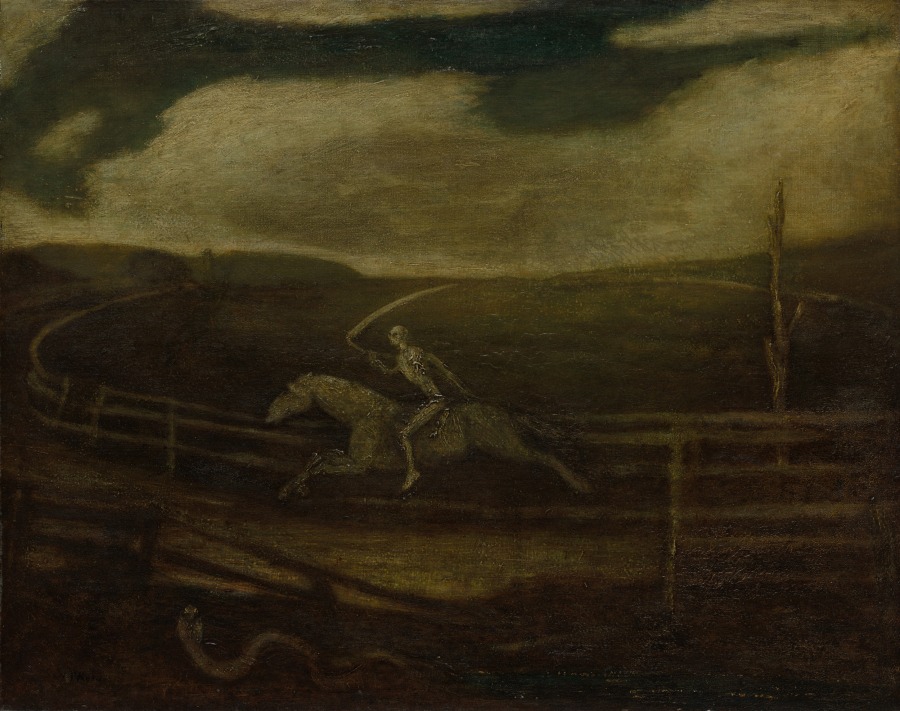
The Race Track (Death on a Pale Horse)
Albert Pinkham Ryder · c. 1896–1908 · Cleveland Museum of Art
What did you think?
Guide
Adjust the guideNew to it · Medium
Nobody has listened to this guide yet. Making it takes about twenty seconds, and after that anyone can hear it straight away.
From the museum
Ryder’s subject was inspired by a horse race that took place in New York during 1888. One of the artist’s friends wagered $500 on the race and then died by suicide after the horse lost. Medieval symbolism infuses the composition: death appears as a skeleton on horseback holding a scythe with which it cuts down the living, while a snake—a sign of temptation and evil—slithers in the foreground. An intense man, Ryder worked on the painting for several years and was deeply reluctant to part with it. Counterclockwise horse racing in the United States was not standardized until the 1920s.
The museum’s own description, in English. Licence: CC0
Ask about this work
Ask in your own words. The answer comes from what the museum has written about the work, and says so when that does not hold it.
Details
- Maker
- Albert Pinkham Ryder (American, 1847–1917)
- Date
- c. 1896–1908
- Medium
- oil on canvas
- Dimensions
- Framed: 84.5 x 102 x 6.5 cm (33 1/4 x 40 3/16 x 2 9/16 in.); Unframed: 70.5 x 90 cm (27 3/4 x 35 7/16 in.)
- Place of origin
- United States
- Held by
- Cleveland Museum of Art, Cleveland · On view · 207 American Realism
- Credit line
- Purchase from the J. H. Wade Fund
Image: Cleveland Museum of Art, CC0
More by Albert Pinkham Ryder
Shown in
- Cleveland Collects American Art of the Gilded AgeFeb 23, 2003 – May 18, 2003
- Conserving the Past for the FutureMar 4, 2001 – May 6, 2001
- Heritage and Horizon: American Painting 1776 - 1976Sep 8, 1976 – Oct 10, 1976
- 35th Anniversary ExhibitionJun 20, 1951 – Sep 30, 1951
- The Silver Jubilee ExhibitionJun 23, 1941 – Sep 28, 1941