Just a moment
Just a moment
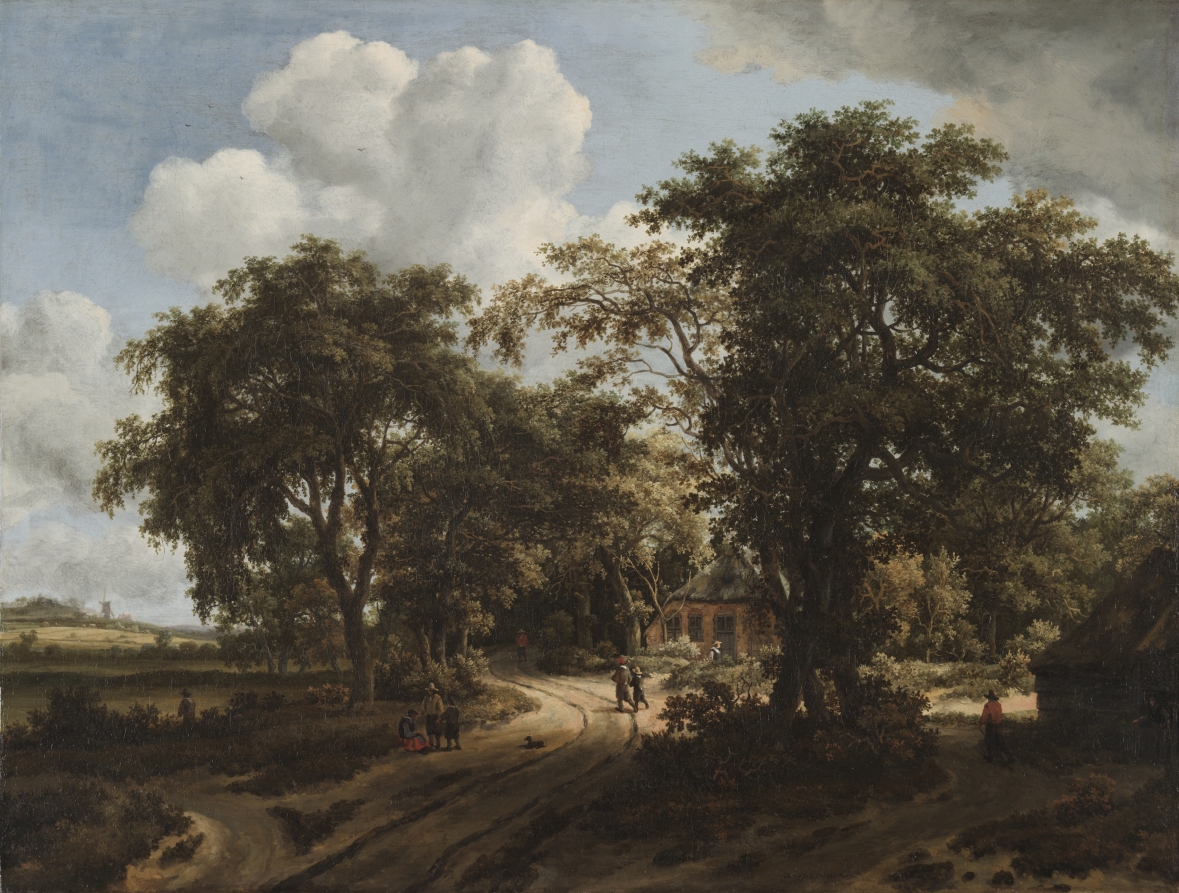
Meindert Hobbema · c. 1665 · Art Institute of Chicago
A closer look, connecting key details with the work’s background.
This is a landscape painted in oil on canvas. It is wider than it is tall, about a metre and ten centimeters across. At its heart is a watermill, a building with a wheel turned by flowing water. The mill stands beside a river, among trees, under a sky with clouds. The title points you to its big red roof, so let your eye start there. Then look around it for the other parts of the scene: the water, a path, a few figures, and ducks. It is an ordinary country corner, painted with care.
Meindert Hobbema was a Dutch painter who lived from 1638 to 1709. He painted this picture around 1665. He was a pupil of another landscape painter, Jacob van Ruisdael, and he often borrowed motifs from his teacher. A motif is a subject or element an artist uses again and again. The watermill seen here is one of those borrowed motifs. Hobbema took to it eagerly. He used watermills more than thirty times in his paintings. They were common along the country waterways of his day, so he had no shortage of models.
To people in Hobbema's time, a watermill carried meaning beyond the building itself. It could stand for human transience, the idea that life passes quickly. It could also stand for Dutch industriousness, the habit of hard work. Now look to the left, along the path, where the figures are farther from you. They are well dressed. The museum reads them as a hint at the rewards of productivity and diligence. Look at them a little longer, and ask yourself how the mill and the path together tell that story.
This guide was written by AI from material published by Art Institute of Chicago. Licence: CC BY 4.0
Save this version (English · New to it · Medium) with all its audio, guide text and work image. It replaces the saved guide for this work and language.
Audio storage: about 40 MB per guide and 150 MB on this device. Audio expires 7 days after it is downloaded.
Save this work’s image and museum information on this device to read without a connection.
Ask in your own words. The answer comes from what the museum has written about the work, and says so when that does not hold it.
Image: Art Institute of Chicago, CC0