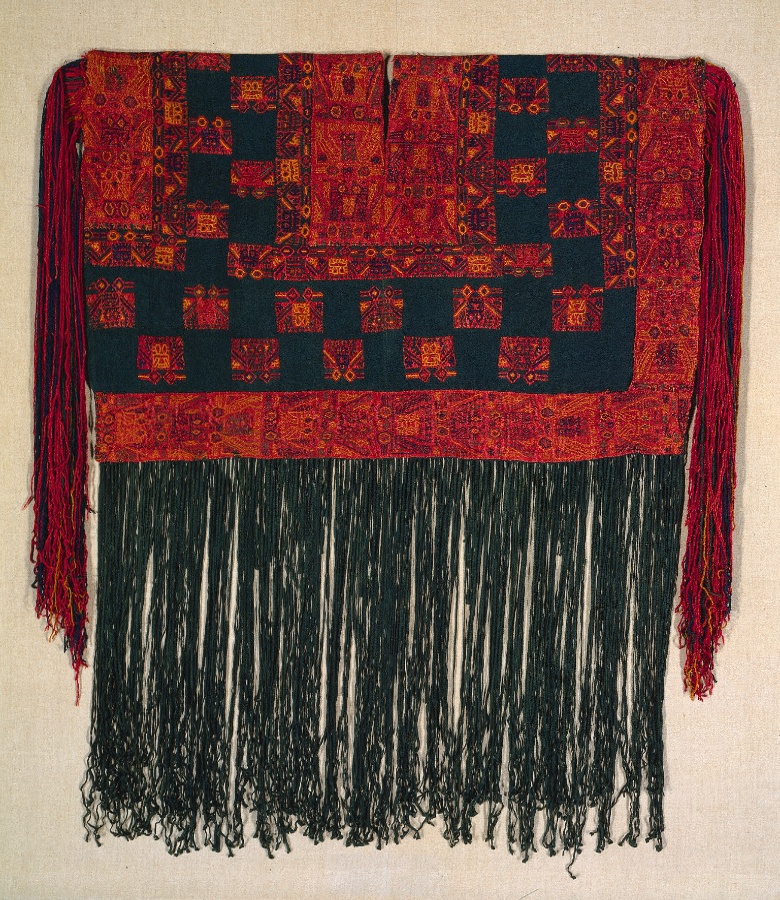
Tunic
Peru, South Coast, Paracas (Cavernas) style · c. 300 BCE–200 CE · Cleveland Museum of Art
What did you think?
Guide
Adjust the guideNew to it · Medium
Nobody has listened to this guide yet. Making it takes about twenty seconds, and after that anyone can hear it straight away.
From the museum
Brightly dyed wool yarns found in many ancient Peruvian textiles come mainly from alpacas that were domesticated and selectively bred to produce long, soft, lustrous fiber. The finely spun yarns in a broad range of colors as seen on this tunic—well preserved after approximately 2,000 years of burial—attest to the Paracas people’s considerable artistry. A double-headed bird motif appears multiple times throughout the tunic’s design. Fine textiles were one of the most prestigious commodities in the ancient Andes.
The museum’s own description, in English. Licence: CC0
Ask about this work
Ask in your own words. The answer comes from what the museum has written about the work, and says so when that does not hold it.
Details
- Maker
- Peru, South Coast, Paracas (Cavernas) style
- Date
- c. 300 BCE–200 CE
- Medium
- Alpaca wool: plain weave with embroidery and warp substitution
- Dimensions
- Overall: 94 x 83.8 cm (37 x 33 in.); Mounted: 111.8 x 101.6 cm (44 x 40 in.)
- Place of origin
- Peru
- Held by
- Cleveland Museum of Art, Cleveland · On view · 232 Andean
- Credit line
- The Norweb Collection
Image: Cleveland Museum of Art, CC0