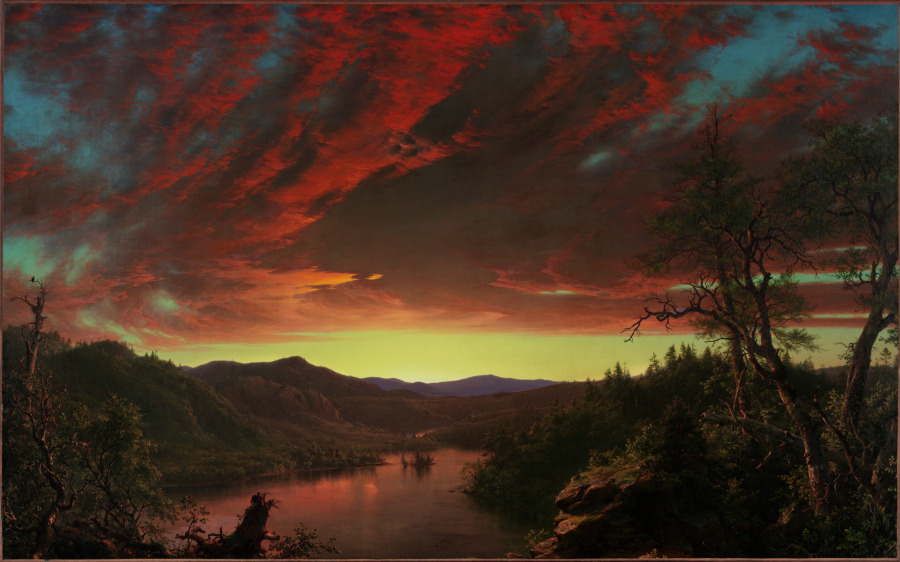
Twilight in the Wilderness
What did you think?
Guide
Adjust the guideNew to it · Medium
Nobody has listened to this guide yet. Making it takes about twenty seconds, and after that anyone can hear it straight away.
From the museum
In his New York studio, Church painted this spectacular view of a blazing sunset over wilderness near Mount Katahdin in Maine, which he had sketched during a visit nearly two years earlier. Although Church often extolled the grandeur of American landscape in his work, this painting appears to have additional overtones. Created on the eve of the Civil War, the painting's subject can be interpreted as symbolically evoking the coming conflagration. Church's considerable technical skills and clever showmanship contributed to his fame as the premier artist of his generation. Rather than debut this painting in an annual exhibition with works by other artists as was the custom, Church instead exhibited it by itself at a prestigious art gallery. Coaxed by advance publicity and highly favorable press reviews, several hundred spectators flocked to admire it during its seven-week run. An image of this painting has a cameo in the Harrison Ford film Clear and Present Danger.
Ask about this work
Ask in your own words. The answer comes from what the museum has written about the work, and says so when that does not hold it.
Details
- Maker
- Frederic Edwin Church (American, 1826–1900)
- Date
- 1860
- Medium
- oil on canvas
- Dimensions
- Unframed: 101.6 x 162.6 cm (40 x 64 in.); Framed: 124 x 185 x 13 cm (48 13/16 x 72 13/16 x 5 1/8 in.)
- Place of origin
- United States
- Held by
- Cleveland Museum of Art, Cleveland · On view · 206 American Landscape
- Credit line
- Mr. and Mrs. William H. Marlatt Fund
Image: Cleveland Museum of Art, CC0