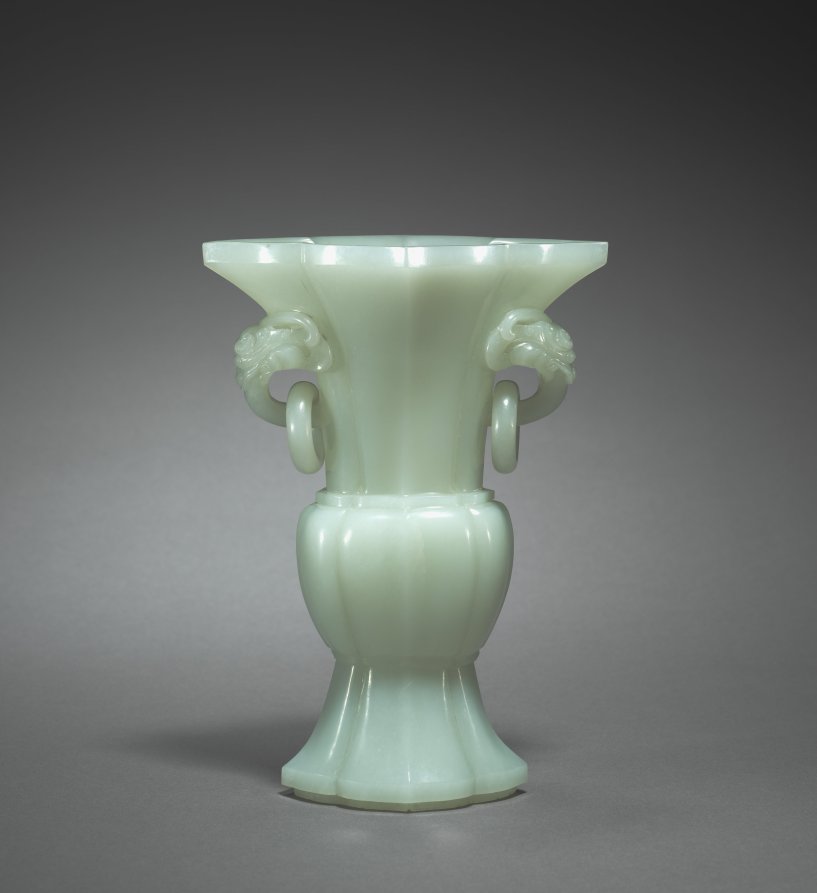
Vase
China, Qing dynasty (1644-1911) · 1700s · Cleveland Museum of Art
What did you think?
Save this work’s image and museum information on this device to read without a connection.
Guide
Adjust the guideNew to it · Medium
Nobody has listened to this guide yet. Making it takes about twenty seconds, and after that anyone can hear it straight away.
From the museum
In the Ming (1368–1644) and Qing (1644–1911) dynasties, luxury items became more affordable to larger parts of the society, including women, merchants, and literati in non-official positions. Imperial patronage and a growing urban population encouraged consumption of luxury goods and local craftmanship. This jade vase has free ring handles suspended from a pair of feline masks. The cross-section of vase is an eight-sided lozenge with curving sides. It illustrates the superb carving skills and the creative mind of its accomplished creator, who sought clients on a competitive market. This jade vase's flaring lip, central band, and flaring foot are derived from archaic bronze zun.
The museum’s own description, in English. Licence: CC0
Ask about this work
Ask in your own words. The answer comes from what the museum has written about the work, and says so when that does not hold it.
Details
- Maker
- China, Qing dynasty (1644-1911)
- Date
- 1700s
- Medium
- jade
- Dimensions
- Overall: 17.2 cm (6 3/4 in.)
- Place of origin
- China
- Held by
- Cleveland Museum of Art, Cleveland · Not on view
- Credit line
- Anonymous Gift
Image: Cleveland Museum of Art, CC0