Just a moment
Just a moment
A closer look, connecting key details with the work’s background.
Looking for this guide.
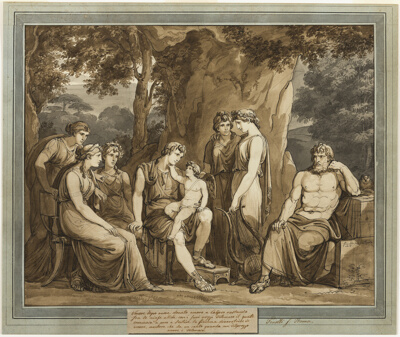
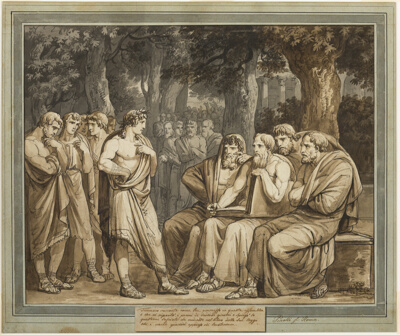
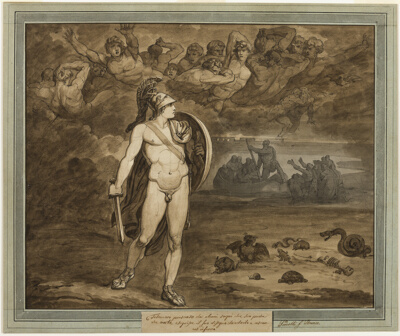
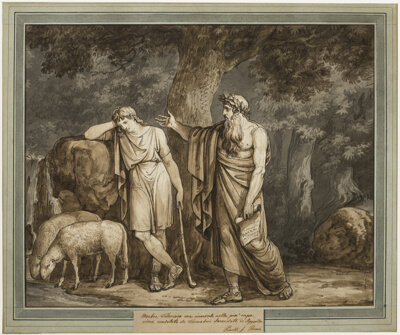
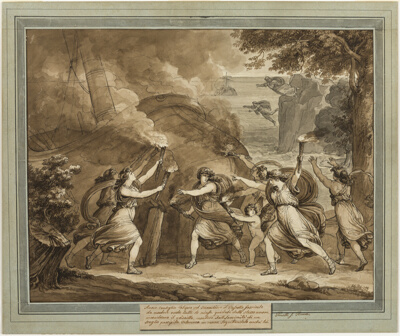
These twelve drawings depict scenes from the French novel The Adventures of Telemachus (Les aventures de Télémaque) by François Fénelon. First published in 1699, it was one of the most popular books of the 1700s and 1800s. Telemachus is the son of Ulysses from Homer’s Odyssey, the first four books of which describe the hero’s search for his father. Fénelon invented further adventures for Telemachus, in which he undergoes many trials while accompanied by his tutor, Mentor, who is actually the goddess Minerva (the embodiment of wisdom) in human disguise. A scathing critique of autocratic government and a diatribe against war, the book denounces luxury and decadence and calls for the simplicity and equality Fénelon believed ancient Greece best exemplified. Pinelli illustrated scenes from books 1–8 and one scene from book 18, and probably planned to illustrate more from the 24 books of the text. Throughout, he celebrates the heroic nude, displaying a deep knowledge of ancient Roman sculpture. His style, influenced by Jacques-Louis David and John Flaxman, is characterized by bold, almost cartoonish contours, monochromatic washes, and frieze-like arrangements of figures. In her passion for Telemachus, and hoping to detain him on her island, Calypso requests the help of the goddess Venus. Here, Venus sends her son Cupid, who is referred to in the inscription as amore (love).
The museum’s own description, in English. Licence: CC BY 4.0
Save this work’s image and museum information on this device to read without a connection.
Ask in your own words. The answer comes from what the museum has written about the work, and says so when that does not hold it.
Image: Art Institute of Chicago, CC0
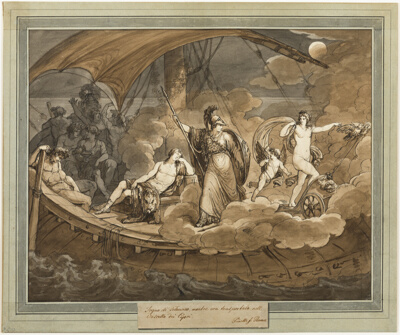 The Dream of Telemachus, from The Adventures of Telemachus, Book 4Bartolomeo Pinelli · 1808
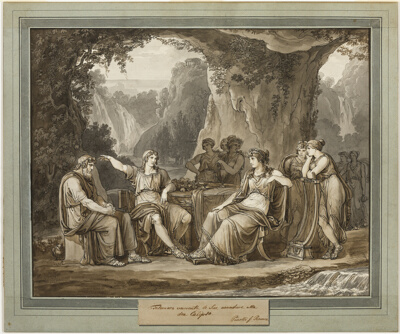 Telemachus Relates His Adventures to the Goddess Calypso, from The Adventures of Telemachus, Book 1Bartolomeo Pinelli · 1808
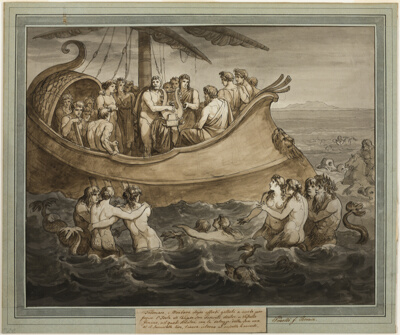 Telemachus and Mentor in a Galley after Fleeing the Island of Calypso, from The Adventures of Telemachus, Book 8Bartolomeo Pinelli · 1808