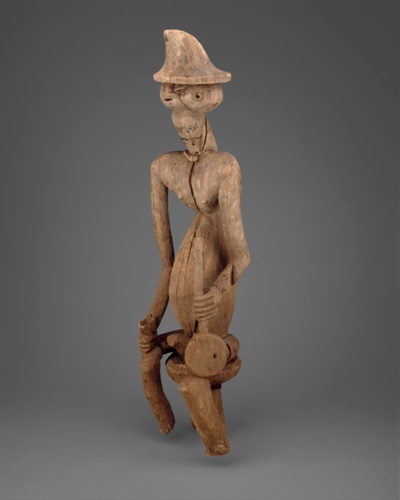
Vessel
Bamileke · Mid-20th century · Art Institute of Chicago
What did you think?
Save this work’s image and museum information on this device to read without a connection.
Guide
Adjust the guideNew to it · Medium
Nobody has listened to this guide yet. Making it takes about twenty seconds, and after that anyone can hear it straight away.
From the museum
The closely situated chiefdoms of Babessi and Nsei, longtime centers of pottery production and regional exchange, adapted to changing demands and clilenteles during the twentieth century. Despite their proximity to each other, the ceramic traditions of Babessi, where only women make pots, and Nsei, where they are made by both sexes, differ significantly. This distinction is most visible in the way that pots are decorated: Babessi potters prefer roulette patterns that appliquéd motifs that complement clay’s placticity, while the Nsei primarily use incising techniques to embellish their wares. A notable example of this can be seen in this elegant old Babessi water container. Its flared lip, narrow neck, and rounded boy, which is textured with a small wooden roulette to the shoulder, are ideal for holding liquid without spilling. In the home a man’s wash basin would have served as the lid for this vessel, its snug fit symbolizing the marriage union, especially as the water pot is itself associated with women and fertility. In a photograph taken by Hans-Joachim Koloss in the chiefdom of Oku, a similarly shaped container is seen being used to prepare medicines. A raised band encircles the pot’s shoulder on which gracefully meander serpents trace a waving line, a motif often found on water containers from Babessi. The serpents are here rendered with front legs, leaving their exact nature ambiguous. While this image is identified as a snake in many parts of the Grassfields, in Babessi it is also associated with a lizard. The market for Babessi pottery tends to be local and conservative in its preferences. In response to this, area potters continue to make wares which are no longer used in more urban areas.
Ask about this work
Ask in your own words. The answer comes from what the museum has written about the work, and says so when that does not hold it.
Details
- Maker
- Bamileke or Bamum, Cameroon
- Date
- Mid-20th century
- Medium
- Terracotta
- Dimensions
- 42 × 41.3 × 41.3 cm (16 1/2 × 16 1/4 × 16 1/4 in.)
- Place of origin
- Cameroon
- Held by
- Art Institute of Chicago, Chicago · On view · Gallery 227
- Credit line
- Gift of Keith Achepohl