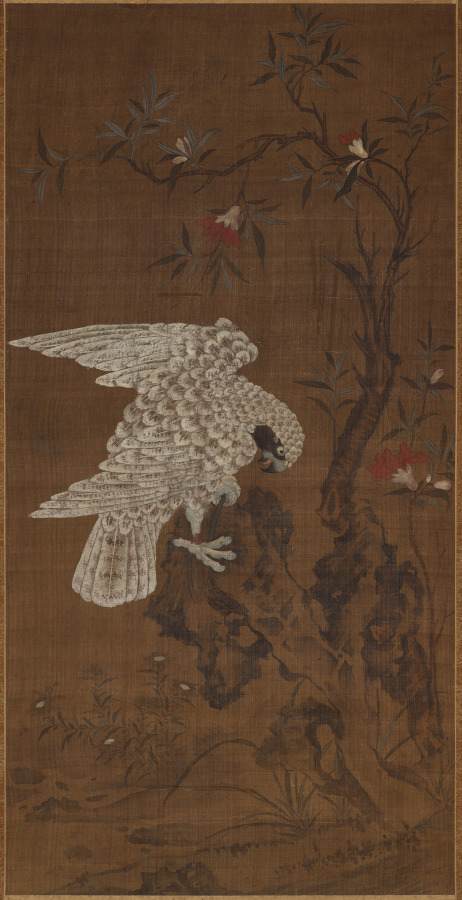
White Falcon
Korea, Joseon dynasty (1392–1910) · 1500s · Cleveland Museum of Art
What did you think?
Guide
Adjust the guideNew to it · Medium
Nobody has listened to this guide yet. Making it takes about twenty seconds, and after that anyone can hear it straight away.
From the museum
The falcon is rendered with highly detailed brushwork, while the surrounding vegetation is depicted with calligraphic lines. This intentional distinction between the carefully managed brushwork of the bird and the expressive treatment of the plants is a key feature of Korean bird-and-flower paintings from the mid-16th and early 17th centuries of the Joseon dynasty (1392–1910) within an established classical style. In premodern East Asia, the white falcon symbolized an individual of strong moral integrity. Thus, falcon paintings were frequently presented as gifts from the king to meritorious court officials.
The museum’s own description, in English. Licence: CC0
Ask about this work
Ask in your own words. The answer comes from what the museum has written about the work, and says so when that does not hold it.
Details
- Maker
- Korea, Joseon dynasty (1392–1910)
- Date
- 1500s
- Medium
- Hanging scroll; ink and color on silk
- Dimensions
- Overall: 86 x 43.2 cm (33 7/8 x 17 in.); Box: 8.9 x 7.6 cm (3 1/2 x 3 in.)
- Place of origin
- Korea
- Held by
- Cleveland Museum of Art, Cleveland · On view · 236 Korean
- Credit line
- Purchase from the Karl B. Goldfield Trust
Image: Cleveland Museum of Art, CC0