Winter, from The Seasons
Charles Le Brun · 1700/20 · Art Institute of Chicago
Guide
4 chapters · about 2 minAdjust the guideNew to it · Medium
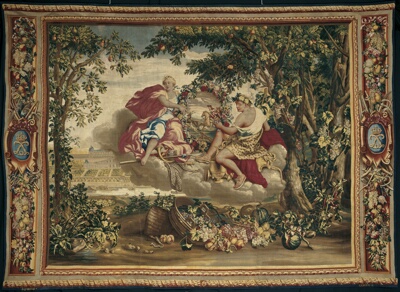
This is a very large tapestry, about five and a half metres tall and nearly four metres wide, woven from wool and silk. A tapestry is a picture woven into cloth rather than painted. It shows winter through gods. Saturn, the god of agriculture and time, and Juventas, the cupbearer to the gods on Mount Olympus, share a large cloud. Below them, the foreground is crowded with winter vegetables and the animals of a hunt. Far off at the right, you can make out city buildings.
Start at the lower part of the tapestry, where the harvest and the hunt are gathered. Look for winter vegetables, a cage, nets, a gun, and game of various kinds. Together they are the results of a successful hunt. Next, find Juventas's feet, where musical instruments and a mask lie. They allude to ballet performances and masked balls, favorite pastimes of the French court. Finally, look to the right in the background. The buildings there can be identified as the Palais du Louvre in Paris.
The design is by Charles Le Brun, who was appointed director of the Gobelins Manufactory in 1663. This tapestry was woven after his design, between 1700 and 1720, at the workshop of Étienne Le Blond and Jean de La Croix at the Manufacture Royale des Gobelins in Paris. The technique is called slit and double interlocking tapestry weave, worked in wool and silk. It comes from a series based on the Four Seasons. The Art Institute of Chicago also holds Autumn from the same series.
The border imitates a gilt wood frame, meaning a frame covered in gold. Shell garlands run above and below cartouches, which are decorative panels. Each panel holds two interlocking Ls under a crown, a cipher of the French king Louis XIV, who reigned from 1643 to 1715. With the Louvre in the background and the court's pastimes at Juventas's feet, the season is tied closely to the king and his court. Look a little longer at the wreath Saturn holds, which features a tiny ballet scene.
This guide was written by AI from material published by Art Institute of Chicago. Licence: CC BY 4.0
Save this version (English · New to it · Medium) with all its audio, guide text and work image. It replaces the saved guide for this work and language.
Audio storage: about 40 MB per guide and 150 MB on this device. Audio expires 7 days after it is downloaded.
What did you think?
Save this work’s image and museum information on this device to read without a connection.
Ask about this work
Ask in your own words. The answer comes from what the museum has written about the work, and says so when that does not hold it.
Details
- Maker
- After a design by Charles Le Brun (French, 1619–1690), Woven at the workshop of Étienne Le Blond (French, 1652–1727) and Jean de La Croix (French, 1628–1712) at the Manufacture Royale des Gobelins, France, Paris
- Date
- 1700/20
- Medium
- Wool and silk, slit and double interlocking tapestry weave
- Dimensions
- 540.1 × 384.9 cm (212 5/8 × 151 1/2 in.)
- Place of origin
- Paris
- Held by
- Art Institute of Chicago, Chicago · Not on view
- Credit line
- Gift of the Hearst Foundation in memory of William Randolph Hearst
Image: Art Institute of Chicago, CC0