Un momento, por favor
Un momento, por favor
Choying Dorje, the Tenth Black Hat Karmapa · 1647–48 or 1658 · Museo de Arte de Cleveland
Una mirada más cercana que conecta los detalles principales con el contexto de la obra.
Buscando esta guía.
Choying Dorje was one of the most influential monastic leaders in the history of Tibetan Buddhism. Known as the Tenth Karmapa, he was the head of the Karma Kagyu order of monks. His biographies state that from a young age he had a talent and passion for carving and painting images of bodhisattvas and other enlightened beings. Several of his original works survive, including this exceptionally rare ivory carving of Avalokiteshvara holding a lotus. Stylistically it is related to images from southwestern China, where he stayed in exile from 1647 to 1648 in the wake of Mongol invasions that destroyed many Kagyu monasteries in Tibet. While there he was exposed to Chinese art, which was favored by his patrons. The face has the distinctive elongation unique to Dorje's personal style. This sculpture could have been made during his time of exile or a decade later after his return to Tibet.
Descripción original del museo, en inglés. Licencia: CC0
Guarda la imagen y la información del museo en este dispositivo para leerlas sin conexión.
Pregunta con tus propias palabras. La respuesta sale de lo que el museo ha escrito sobre la obra, y lo dice cuando ahí no está.
Imagen: Cleveland Museum of Art, CC0
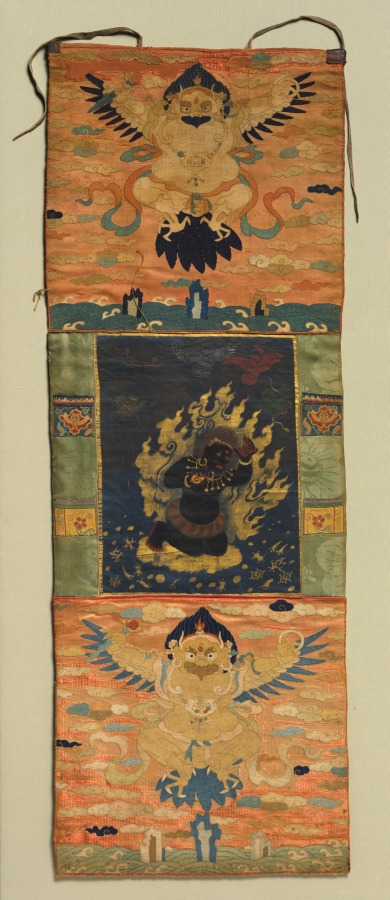 Vajrapani and GarudaChoying Dorje, the Tenth Black Hat Karmapa · painting c. 1650; top and bottom borders c. 1350
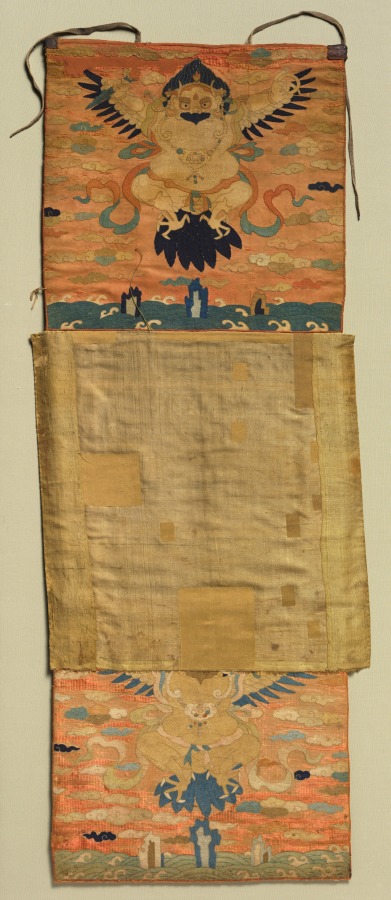 Vajrapani Embroidered Mount with GarudaChoying Dorje, the Tenth Black Hat Karmapa · painting 1600s, embroidery c. 1300
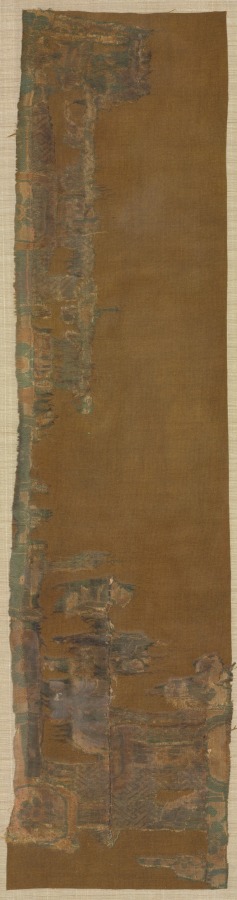 Vajrapani Embroidered Mount with GarudaChoying Dorje, the Tenth Black Hat Karmapa · painting 1600s, embroidery c. 1300
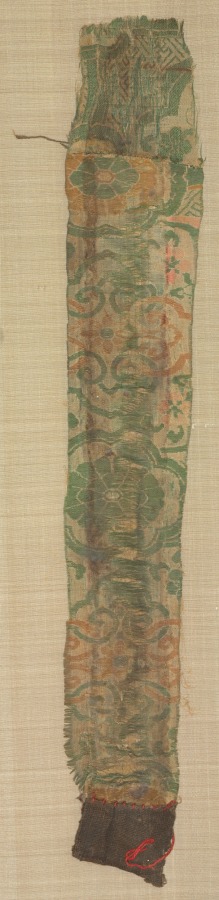
 Vajrapani Embroidered Mount with GarudaChoying Dorje, the Tenth Black Hat Karmapa · painting 1600s, embroidery c. 1300