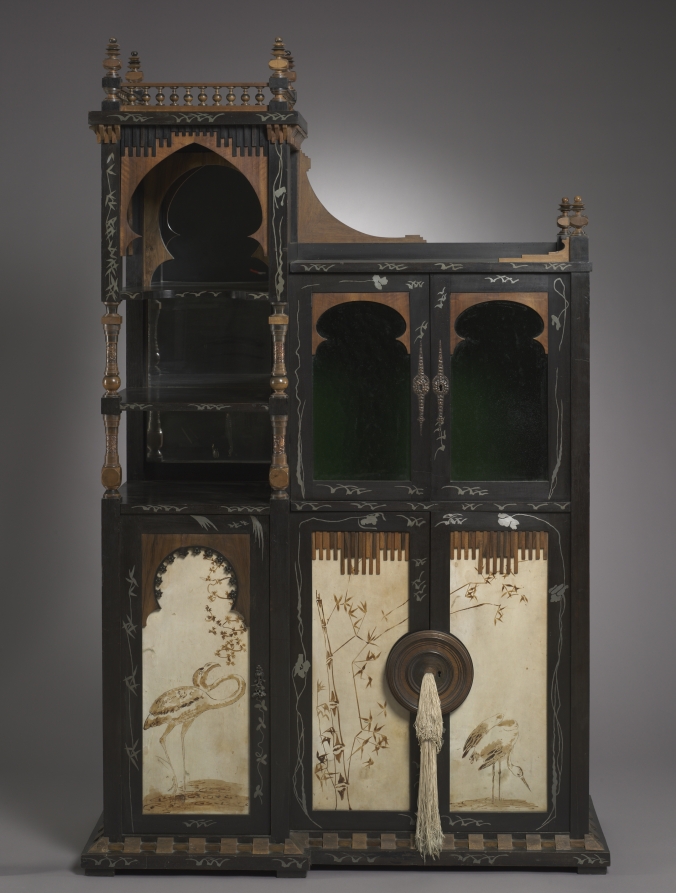
Cabinet
Carlo Bugatti · c. 1895 · Museo de Arte de Cleveland
¿Qué te ha parecido?
Guarda la imagen y la información del museo en este dispositivo para leerlas sin conexión.
Guía
Ajustar la guíaPrincipiante · Media
Nadie ha escuchado todavía esta guía. Prepararla lleva unos veinte segundos y, después, cualquiera podrá escucharla al momento.
Texto del museo
In both form and decoration this cabinet typifies the work of Carlo Bugatti. Asymmetrical, with a tower-like element at one side, there are Islamic-inspired ornaments throughout its design, notably the onion-shaped arches in the upper half of the cabinet. Japanese influence is also evident in the white metal inlays and in the sepia-painted parchment panels. The cabinet displays an extensive vocabulary of other decorative devices, including the partial ebonized frame, the turned wooden ornaments, metal reliefs, mirrored and green glass, and silk tassels. Despite their diversity, Bugatti organized all these elements into a coherent design. Carlo Bugatti's sons achieved illustrious careers of their own. Rembrandt Bugatti (1884-1916) became a celebrated sculptor, and Ettore Bugatti (1881-1947) manufactured luxurious automobiles and racing cars.
Pregunta sobre esta obra
Pregunta con tus propias palabras. La respuesta sale de lo que el museo ha escrito sobre la obra, y lo dice cuando ahí no está.
Detalles
- Autor
- Carlo Bugatti (Italian, 1856–1940)
- Fecha
- c. 1895
- Técnica
- wood with metal inlays and painted parchment, glass doors and mirror
- Dimensiones
- Overall: 224.5 x 141 x 55.3 cm (88 3/8 x 55 1/2 x 21 3/4 in.)
- Lugar de origen
- France
- Colección
- Museo de Arte de Cleveland, Cleveland · En sala · 221 19th Century Decorative Arts
- Procedencia
- Gift of Barry Friedman and Patricia Pastor, New York
Imagen: Cleveland Museum of Art, CC0