Un momento, por favor
Un momento, por favor
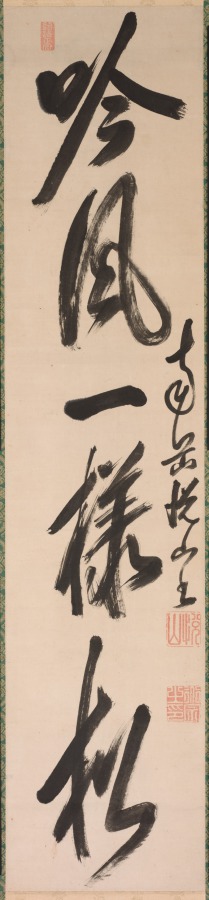
Yueshan Daozong · c. 1660–1709 · Museo de Arte de Cleveland
Una mirada más cercana que conecta los detalles principales con el contexto de la obra.
Buscando esta guía.
This spontaneous, bold calligraphy style is characteristic of members of the Japanese Ōbaku school (Huangbo in Chinese) of Chan (Zen in Japanese) Buddhism, which was founded in Japan by Chinese monks in the 1600s. The monk Yueshan emigrated to Japan from the Chinese province of Fujian, taking a priestly post at Manpukuji, the headquarters of the Ōbaku school in Japan. He later became the seventh abbot of the distinguished temple. Yueshan’s calligraphy features rounded characters that allow him to fuse strokes and characters in speedy brush movements. Here the text begins with the large character chu (初, “the beginning”), the initial focus of meditation on the text: The dragon murmurs after sunset. The tiger roars before dawn. Ōbaku-style calligraphy favors rounded—rather than angular—brushstrokes. It is not a subtle style of calligraphy, as the Chan monks preferred a bold approach.
Descripción original del museo, en inglés. Licencia: CC0
Guarda la imagen y la información del museo en este dispositivo para leerlas sin conexión.
Pregunta con tus propias palabras. La respuesta sale de lo que el museo ha escrito sobre la obra, y lo dice cuando ahí no está.
Imagen: Cleveland Museum of Art, CC0