Chandelier
Augustus Welby Northmore Pugin · 1852 · Instituto de Arte de Chicago
Guía
Ajustar la guíaPrincipiante · Media
Buscando esta guía.
Texto del museo
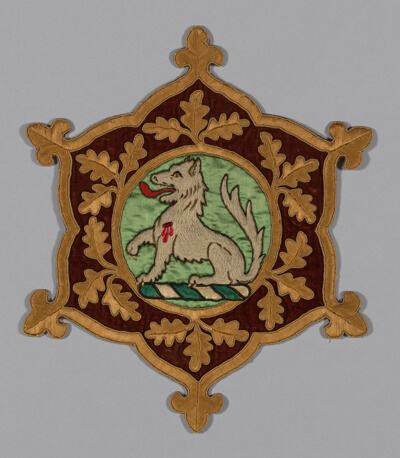
The motifs on this chandelier—including trefoils, quatrefoils, and scrolling foliage—were favorites of designer Augustus Welby Northmore Pugin, who was inspired by the ornamentation of medieval architecture. A leading figure in the Gothic Revival and a convert to Catholicism, Pugin believed that a return to Gothic design in both religious and secular settings would help England reconnect with what he viewed as the superior morals and society of the medieval period. Pugin introduced this style of chandelier, which combines the medieval Flemish tradition of brass casting with the technical capabilities of industrial manufacturing, at London’s Crystal Palace Exhibition of 1851. This particular piece, which is among his most monumental designs for domestic spaces, was commissioned by Henrietta Pole in 1853 for Aldenham Abbey (also known as Wall Hall) in Hertfordshire, England, where it remained for over a century. The coats of arms of her family and her husband, Sir William Stuart, hang between the lower branches.
Descripción original del museo, en inglés. Licencia: CC BY 4.0
¿Qué te ha parecido?
Guarda la imagen y la información del museo en este dispositivo para leerlas sin conexión.
Pregunta sobre esta obra
Pregunta con tus propias palabras. La respuesta sale de lo que el museo ha escrito sobre la obra, y lo dice cuando ahí no está.
Detalles
- Autor
- Augustus Welby Northmore Pugin, English, 1812-1852, Manufactured by John Hardman and Company, Birmingham, England, founded 1838
- Fecha
- 1852
- Técnica
- Brass and enamels
- Dimensiones
- 304.8 × 238.8 cm (120 × 94 in.)
- Lugar de origen
- England
- Colección
- Instituto de Arte de Chicago, Chicago · En sala · Gallery 235
- Procedencia
- Major Acquisition Fund; John H. and Neville Bryan Endowment Fund; Richard T. Crane Jr. Memorial Fund
Imagen: Art Institute of Chicago, CC0