Un momento, por favor
Un momento, por favor
Rembrandt van Rijn · 1653-c.1660 · Museo de Arte de Cleveland
Una mirada más cercana que conecta los detalles principales con el contexto de la obra.
Buscando esta guía.
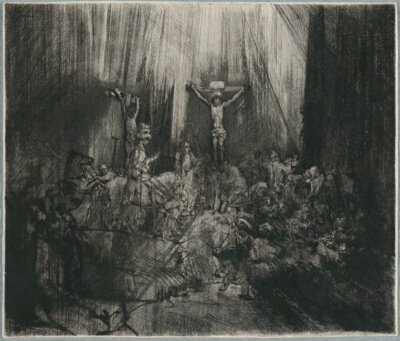
Rembrandt’s Christ Crucified Between the Two Thieves is executed entirely in drypoint. Because of the delicacy of the technique, the copper plate was worn after the artist printed about 40 impressions of the first three states. In order to continue using the plate, Rembrandt reworked it, changing the image somewhat. In this fourth state, slashing strokes obscure the spectators visible in the earlier version, creating a tenebrous setting that focuses attention on Christ bathed in celestial light. Although drypoint is an inherently linear medium, Rembrandt used it to obtain tonal qualities associated with painting. The blackness becomes an active force that threatens to extinguish the light of Christ—a literal illustration of the Evangelist Luke’s description of the event that brought "a darkness over all the earth." When he printed this impression, Rembrandt deliberately left ink on the printing plate, specifically on the left and right sides, essentially creating a unique work.
Descripción original del museo, en inglés. Licencia: CC0
Guarda la imagen y la información del museo en este dispositivo para leerlas sin conexión.
Pregunta con tus propias palabras. La respuesta sale de lo que el museo ha escrito sobre la obra, y lo dice cuando ahí no está.
Imagen: Cleveland Museum of Art, CC0