Clock
Henrik Wigström · c. 1905–15 · Museo de Arte de Cleveland
Guía
Ajustar la guíaPrincipiante · Media
Nadie ha escuchado todavía esta guía. Prepararla lleva unos veinte segundos y, después, cualquiera podrá escucharla al momento.
Texto del museo
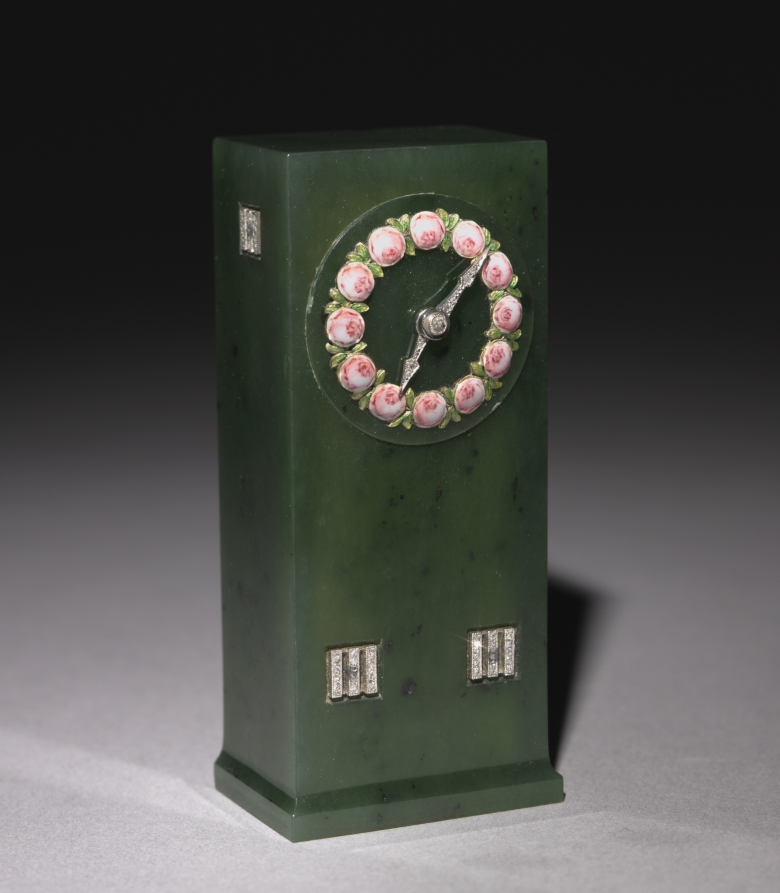
The use of Russian hardstones in creating precious objects became a hallmark of design from the House of Fabergé. Easily carved, these minerals were sourced largely from the western region surrounding the Ural Mountains. Fabergé's workmasters used colorful stones such as agate, nephrite (jade), lapis lazuli, rock crystal, and rhodonite, seen here in this small desk clock, to create and embellish flower studies, animal figures, and all manner of luxurious accessories. Bright pink rhodonite was among the rarest, and consequently most expensive, specimens used by the House of Fabergé. The bright pink color of this small desk clock is a result of manganese, the principle mineral found in rhodonite.
Descripción original del museo, en inglés. Licencia: CC0
¿Qué te ha parecido?
Guarda la imagen y la información del museo en este dispositivo para leerlas sin conexión.
Pregunta sobre esta obra
Pregunta con tus propias palabras. La respuesta sale de lo que el museo ha escrito sobre la obra, y lo dice cuando ahí no está.
Detalles
- Autor
- Henrik Wigström (Russian, 1862–1923), House of Fabergé (Russian, 1842–1918)
- Fecha
- c. 1905–15
- Técnica
- rhodonite, silver, enamel, diamonds
- Dimensiones
- Overall: 5.3 x 5 x 2.9 cm (2 1/16 x 1 15/16 x 1 1/8 in.)
- Lugar de origen
- Russia
- Colección
- Museo de Arte de Cleveland, Cleveland · En sala · 211 Fabergé
- Procedencia
- The India Early Minshall Collection
Imagen: Cleveland Museum of Art, CC0