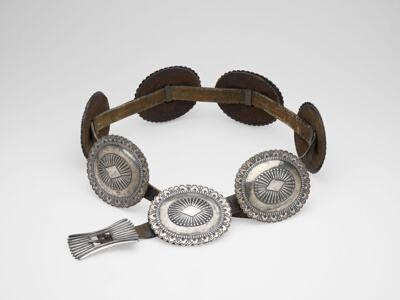
Concho Belt
Navajo (Diné) · 1880–95 · Instituto de Arte de Chicago
Guía
Ajustar la guíaPrincipiante · Media
Buscando esta guía.
Texto del museo
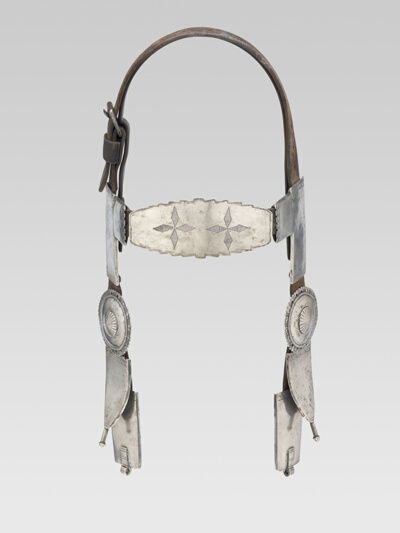
During the 1860s and early 1870s, Navajos (Diné) learned silversmithing from Hispanic artisans in New Mexico, and Plains Indian craftsmen whose own metalwork stemmed from Colonial sources in the eastern United States. Mexican pesos, U.S. American dollars, and ingot silver were melted down and recast in molds carved from soft volcanic tufa. Navajo silversmiths employed steel tools and punches to develop decorative patterns. Early concho belts, bow guards, bracelets, necklaces, horse headstalls, and other items of silver jewelry display massive forms and simple ornamentation. By the 1890s turquoise was increasingly used; although most turquoise was obtained from Southwestern sources, some was imported from China and Iran. Navajo silversmiths rapidly established a distinctive elegant style that has become one of the classic hallmarks of Native American art in the greater Southwest. Today, Navajo jewelry, like that of their neighboring Pueblo neighbors, exhibit much greater complexity of design and the use of diverse semiprecious stones, shell, and a variety of metals.
Descripción original del museo, en inglés. Licencia: CC BY 4.0
¿Qué te ha parecido?
Guarda la imagen y la información del museo en este dispositivo para leerlas sin conexión.
Pregunta sobre esta obra
Pregunta con tus propias palabras. La respuesta sale de lo que el museo ha escrito sobre la obra, y lo dice cuando ahí no está.
Detalles
- Autor
- Navajo (Diné), Northern New Mexico or Arizona, United States
- Fecha
- 1880–95
- Técnica
- Silver and leather
- Dimensiones
- H.: 101.6 cm (40 in.)
- Lugar de origen
- Arizona
- Colección
- Instituto de Arte de Chicago, Chicago · No expuesta
- Procedencia
- Auxiliary Board of the Art Institute of Chicago
Imagen: Art Institute of Chicago, CC0