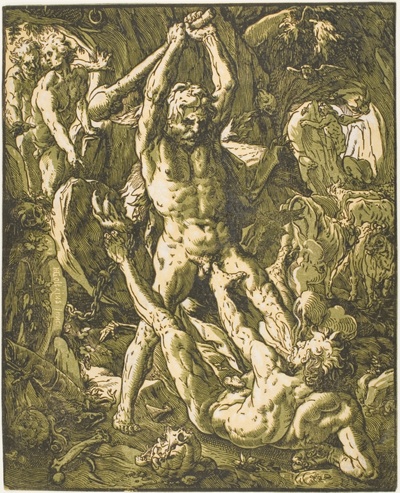
Hercules and Telephos
Guía
Ajustar la guíaPrincipiante · Media
Buscando esta guía.
Texto del museo
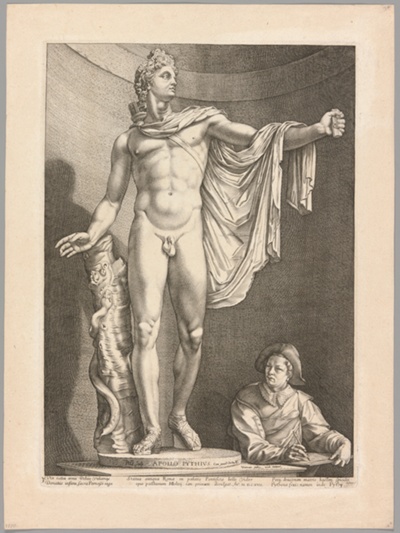
Hendrick Goltzius was one of many late Renaissance artists who felt compelled to travel to Italy as part of his artistic training. He went with one purpose—to study antique sculpture. Goltzius made drawings on-site and then made engravings after his designs once he returned to Haarlem in 1591. He portrayed the Hercules Telephos from a low viewpoint to capture the awesome experience of first encountering the famous monument. It stands within a shadowed niche, which Goltzius filled with thousands of crossed engraved lines to create a dramatic recess that pushes the sculpture into the light. The engraving shows to excellent advantage the virtuosic technique that Goltzius developed, in which the swelling and tapering line exaggerates the heroic musculature of the figure. The 2nd-century Hercules Telephos was unearthed in the Campo de’Fiori in Rome and was on view at the Belvedere Courtyard of the Vatican by the time Hendrick Goltzius visited the city.
Descripción original del museo, en inglés. Licencia: CC0
¿Qué te ha parecido?
Guarda la imagen y la información del museo en este dispositivo para leerlas sin conexión.
Pregunta sobre esta obra
Pregunta con tus propias palabras. La respuesta sale de lo que el museo ha escrito sobre la obra, y lo dice cuando ahí no está.
Detalles
- Autor
- Hendrick Goltzius (Dutch, 1558–1617)
- Fecha
- 1592
- Técnica
- engraving
- Dimensiones
- Platemark: 40.4 x 29.4 cm (15 7/8 x 11 9/16 in.); Sheet: 41.8 x 30.1 cm (16 7/16 x 11 7/8 in.)
- Lugar de origen
- Netherlands
- Colección
- Museo de Arte de Cleveland, Cleveland · No expuesta
- Procedencia
- Severance and Greta Millikin Purchase Fund
Imagen: Cleveland Museum of Art, CC0