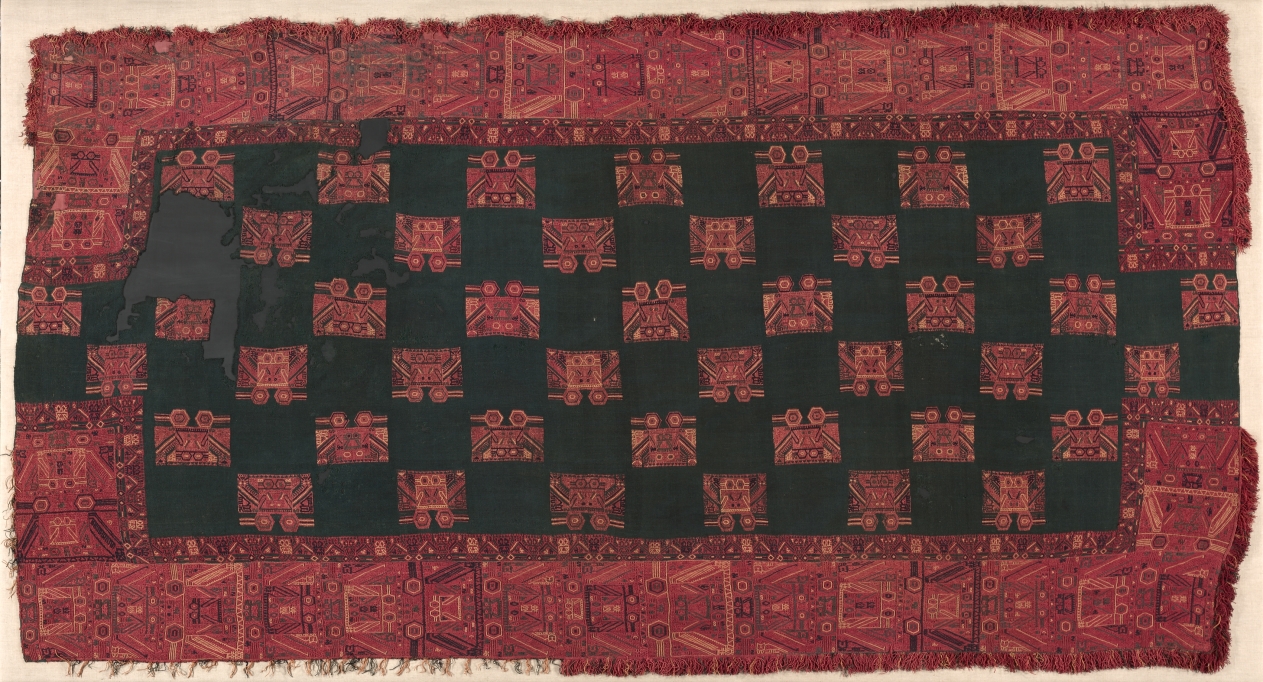
Mantle
Peru, South Coast, Paracas (Cavernas) style · c. 300 BCE–200 CE · Museo de Arte de Cleveland
¿Qué te ha parecido?
Guarda la imagen y la información del museo en este dispositivo para leerlas sin conexión.
Guía
Ajustar la guíaPrincipiante · Media
Nadie ha escuchado todavía esta guía. Prepararla lleva unos veinte segundos y, después, cualquiera podrá escucharla al momento.
Texto del museo
Buried in shaft-tombs, or rectangular sunken chambers, the Paracas dead were wrapped in layers of cloth and accompanied by pottery, food, and other offerings. The dry environment of the Paracas Peninsula helped preserve many of these textiles, including richly ornamented garments buried with important individuals. This mantle, probably worn like a cloak, relates closely to the tunic (CMA 1946.227) and long headband (CMA 1946.228) due to their shared imagery. Its double-headed bird motifs— embroidered in vivid red, blue, yellow, and green yarns—likely had symbolic significance, although the specific meaning remains unknown. The profusion and decoration of textiles in Paracas burials shows the value placed on cloth.
Pregunta sobre esta obra
Pregunta con tus propias palabras. La respuesta sale de lo que el museo ha escrito sobre la obra, y lo dice cuando ahí no está.
Detalles
- Autor
- Peru, South Coast, Paracas (Cavernas) style
- Fecha
- c. 300 BCE–200 CE
- Técnica
- camelid fiber: plain weave with embroidery
- Dimensiones
- Overall: 154.9 x 292.1 cm (61 x 115 in.); Mounted: 162.6 x 299.7 cm (64 x 118 in.)
- Lugar de origen
- Peru
- Colección
- Museo de Arte de Cleveland, Cleveland · En sala · 232 Andean
- Procedencia
- The Norweb Collection
Imagen: Cleveland Museum of Art, CC0