Un momento, por favor
Un momento, por favor
John I Smart · c. 1775 · Museo de Arte de Cleveland
Una mirada más cercana que conecta los detalles principales con el contexto de la obra.
Buscando esta guía.
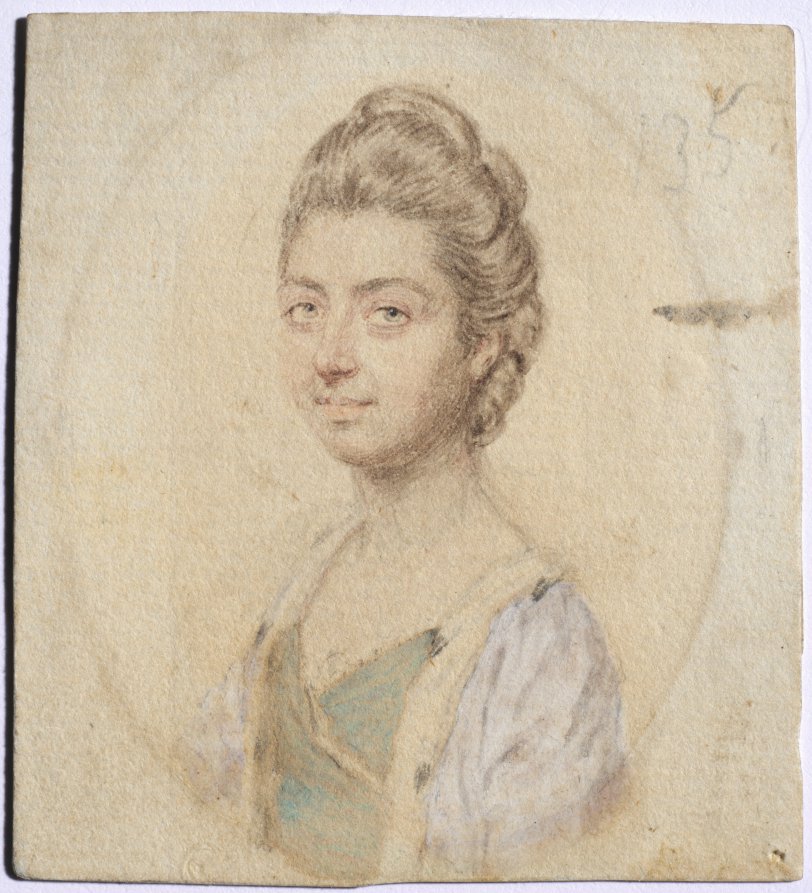
This portrait was assigned the historically colorful but fictitious title of “Anne of Denmark” at some point after memory of its true identity had been lost. Giving illustrious titles to portraits of unknown sitters was a popular strategy adopted by dealers during the nineteenth and twentieth centuries, often applied to miniature portraits and, in particular, to Smart’s sketches of women. Only the sitter’s head and neck are drawn, and a low-necked dress is faintly suggested. Her head is turned to the left, and her brown hair is dressed high, with flat curls against the back of her head. A lightly drawn veil falls over the back of the hair and shoulders. The sitter’s sagging jaw line and the lines beneath her blue-green eyes suggest that she was painted as a mature woman. The sketch is generally faded, and the background is unpainted. The finished ivory miniature for which this drawing was presumably a preparatory sketch has not yet been discovered. The sitter’s identification has been based on a later inscription in graphite on the verso of the paper backing. When the paper backing was removed from the back of the drawing in 2011, an inscription in brown ink in the artist’s hand was discovered. The writing appears to be a fragment, created when the small rectangle containing the portrait was cut from a larger sheet. It reads, “to be set[?] in . . . / and put in a Black / Frame largest . . . / [G . . .’s?] Size.” Above this, “very dark brown hair” is written in graphite. Mrs. A. Dean Perry, who donated this drawing to CMA, is the granddaughter of one of the museum’s founding members, Jeptha Homer Wade II.
Descripción original del museo, en inglés. Licencia: CC0
Guarda la imagen y la información del museo en este dispositivo para leerlas sin conexión.
Pregunta con tus propias palabras. La respuesta sale de lo que el museo ha escrito sobre la obra, y lo dice cuando ahí no está.
Imagen: Cleveland Museum of Art, CC0