Un momento, por favor
Un momento, por favor
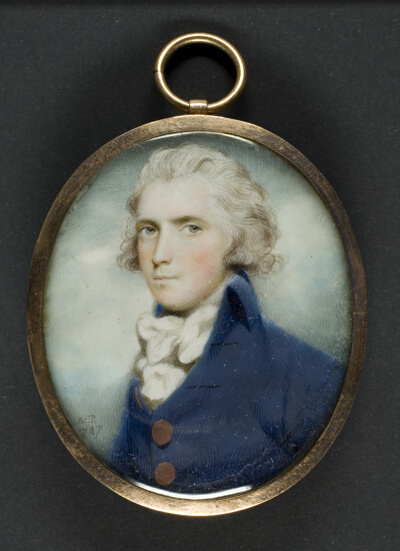
Andrew Plimer · c. 1805 · Museo de Arte de Cleveland
Una mirada más cercana que conecta los detalles principales con el contexto de la obra.
Buscando esta guía.
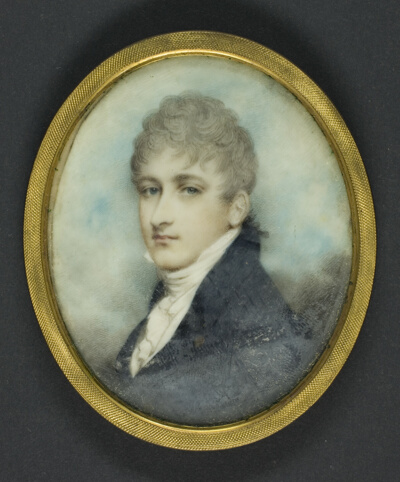
This miniature is an extremely fi ne example of Andrew Plimer’s mature work. Painted around 1805, the artist eschews the Richard Cosway-esque blue sky background he so often adopted for an elaborate network of crosshatching over a rich brown ground, into which the sitter almost dissolves. He has gray eyes and light brown hair and wears a grayish-brown coat and a white collar. His gaze firmly meets that of the viewer. The painting is housed in its original gold frame, the verso of which has a curl of light brown hair fastened with a band of pearls on white opalescent glass under clear glass. There is also a paper label of unknown origin at the top, on which is written “226.” The sitter’s hair is worn à l’antique (hair cut short and worn in curls, especially around the forehead), a style sported by men after the turn of the century that harks back to the coiffures of statesmen of ancient Rome.1 In addition, this sitter’s brown hair is completely unpowdered, as was fashionable among young men at the turn of the century. The hair is beautifully delineated by small, undulating parallel lines. This sitter has been traditionally identified as a member of the famous Baring banking family. There is a miniature portrait of Thomas Baring (1772–1848) painted by George Engleheart (1752–1829) in 1803 in the museum’s collection. His brother George Baring (1781–1854) was also painted by Engleheart around 1805. The young man in this portrait by Plimer might also be one of the other three Baring brothers: Alexander, 1st Baron Ashburton (1774–1848), Henry (1776–1848), or William (1779–1820). Of the four brothers with extant portraits, the Plimer sitter bears the closest resemblance to Alexander because of his piercing, narrow eyes. Yet the c. 1810 portrait of Alexander by Thomas Lawrence is too dissimilar, having features that could not have been the product of an intervening period of only five years. Since it does not bear a striking likeness to any of these extant portraits, this miniature cannot be definitively identified as a member of the Baring family. Both of the Baring family portrait miniatures in Cleveland’s collection were purchased by Edward Greene from the dealer Leo Schidlof on 6 August 1928, suggesting that they may have come from the same collection before entering into Schidlof’s hands. This sitter has been traditionally identified as a member of the famous Baring banking family although which brother we are unsure.
Descripción original del museo, en inglés. Licencia: CC0
Guarda la imagen y la información del museo en este dispositivo para leerlas sin conexión.
Pregunta con tus propias palabras. La respuesta sale de lo que el museo ha escrito sobre la obra, y lo dice cuando ahí no está.
Imagen: Cleveland Museum of Art, CC0