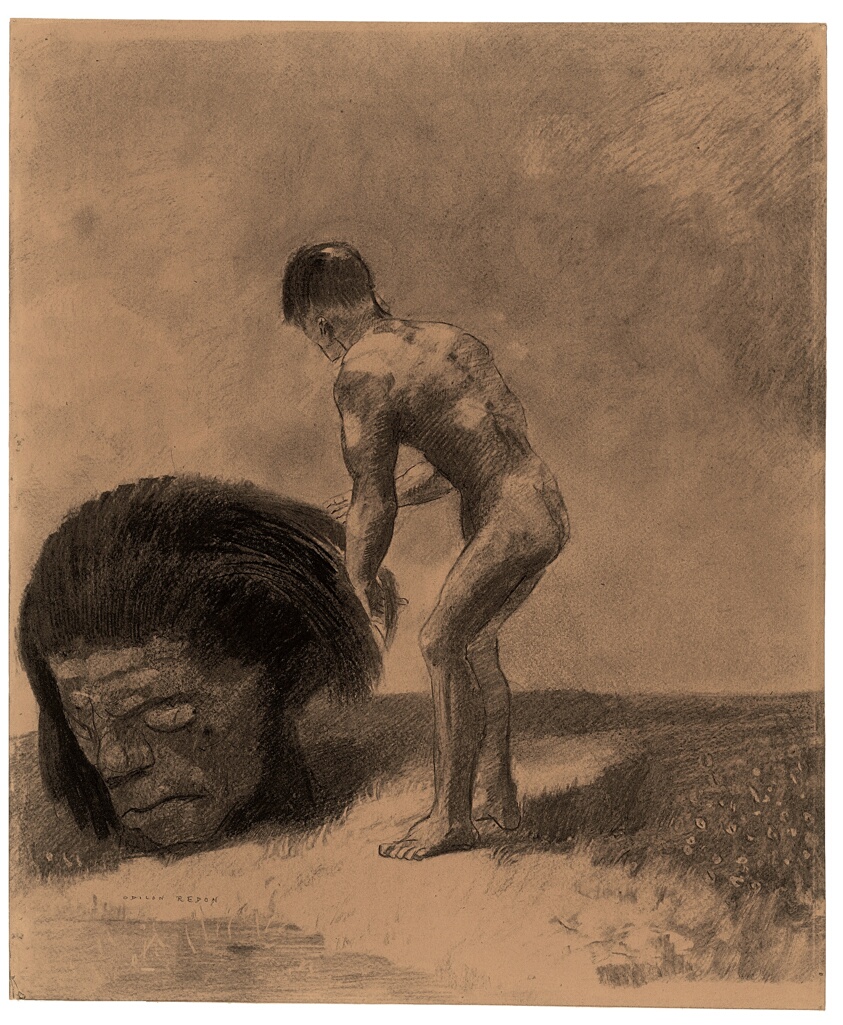
Primitive Being
Odilon Redon · c. 1876 · Instituto de Arte de Chicago
¿Qué te ha parecido?
Guarda la imagen y la información del museo en este dispositivo para leerlas sin conexión.
Guía
Ajustar la guíaPrincipiante · Media
Nadie ha escuchado todavía esta guía. Prepararla lleva unos veinte segundos y, después, cualquiera podrá escucharla al momento.
Texto del museo
Odilon Redon himself described this drawing as representing “a primitive being contemplating the head of a giant.” During Redon’s life, new ideas of evolution provoked a fascination with other societies that were unmediated by industrialization and which Europeans viewed as “primitive” and closer to the natural world. Redon’s figures relate to these racially insensitive romanticized stereotypes, while also revealing other windows of creative thought. Although the work evokes the biblical story of David and Goliath, its mood is mysterious and reflective rather than triumphant. This is one of Redon’s celebrated black-and-white works he called “noirs” (blacks), which were strange, often disturbing images derived from the subconscious mind or dream world. In them, the artist deftly applied velvety charcoal and black chalk using a repertory of techniques—wiping, rubbing, erasing—to bring out a rich variety of tonal, chromatic, and textural effects.
Pregunta sobre esta obra
Pregunta con tus propias palabras. La respuesta sale de lo que el museo ha escrito sobre la obra, y lo dice cuando ahí no está.
Detalles
- Autor
- Odilon Redon, French, 1840–1916
- Fecha
- c. 1876
- Técnica
- Various charcoals and black chalk, with stumping, wiping, and erasing, fixed, on cream wove paper
- Dimensiones
- 44.5 × 36.9 cm (17 9/16 × 14 9/16 in.)
- Lugar de origen
- France
- Colección
- Instituto de Arte de Chicago, Chicago · No expuesta
- Procedencia
- Gift of Richard and Mary L. Gray
Imagen: Art Institute of Chicago, CC0