
Un momento, por favor
Un momento, por favor
Una mirada más cercana que conecta los detalles principales con el contexto de la obra.
Buscando esta guía.
Documenting archeological sites in Egypt and Algeria, John Beasly Greene produced fewer than 350 images in a mere four years (he died on his third trip to Egypt at the age of twenty-four). Greene’s twin pursuits of photography and archeology matched the larger 18th- and 19th-century penchant for memorializing lost civilizations through the wonders of modern technology. From the photographer Gustave Le Gray, Greene learned the newly perfected waxed-paper negative (a salted paper print technique), a process that was relatively easy to use in the field and which offered good tonal range as well as detail. In December 1855, he joined a French expedition to Algeria as the official photographer for the excavation of the Tomb of the Christian Woman, located outside Algiers. His pictures of the burial mound are enigmatic, focusing on the overall form of the structure rather than on particular archeological details.
Descripción original del museo, en inglés. Licencia: CC BY 4.0
Guarda la imagen y la información del museo en este dispositivo para leerlas sin conexión.
Pregunta con tus propias palabras. La respuesta sale de lo que el museo ha escrito sobre la obra, y lo dice cuando ahí no está.
Imagen: Art Institute of Chicago, CC0
 View of LuxorJohn Beasley Greene · 1854
 The SphinxJohn Beasley Greene · c. 1853
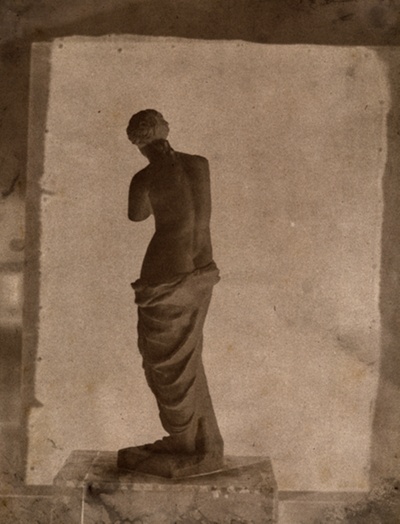 Untitled (Still life with a statuette of the Venus de Milo)John Beasley Greene · 1852-53
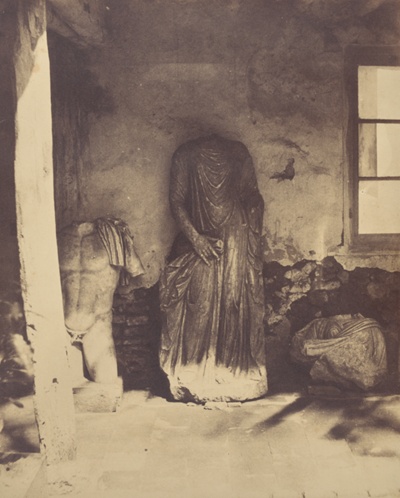 Untitled [Roman sculptures, Cherchell Museum]John Beasley Greene · 1856
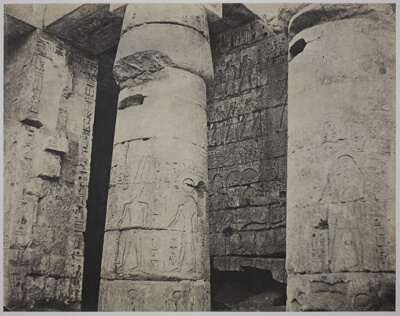 Medinet Habu, Mortuary Temple of Ramses III, Left Wall (Médinet-Habou, Temple funéraire de Ramsès III, paroi gaucheJohn Beasley Greene · 1854