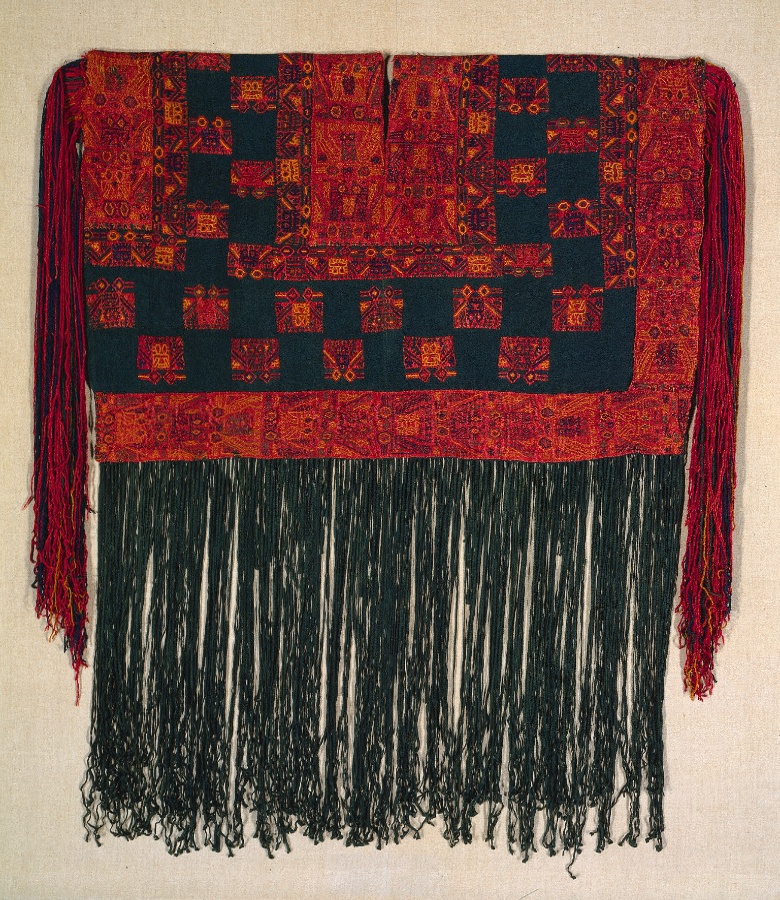
Tunic
Peru, South Coast, Paracas (Cavernas) style · c. 300 BCE–200 CE · Museo de Arte de Cleveland
¿Qué te ha parecido?
Guía
Ajustar la guíaPrincipiante · Media
Nadie ha escuchado todavía esta guía. Prepararla lleva unos veinte segundos y, después, cualquiera podrá escucharla al momento.
Texto del museo
Brightly dyed wool yarns found in many ancient Peruvian textiles come mainly from alpacas that were domesticated and selectively bred to produce long, soft, lustrous fiber. The finely spun yarns in a broad range of colors as seen on this tunic—well preserved after approximately 2,000 years of burial—attest to the Paracas people’s considerable artistry. A double-headed bird motif appears multiple times throughout the tunic’s design. Fine textiles were one of the most prestigious commodities in the ancient Andes.
Descripción original del museo, en inglés. Licencia: CC0
Pregunta sobre esta obra
Pregunta con tus propias palabras. La respuesta sale de lo que el museo ha escrito sobre la obra, y lo dice cuando ahí no está.
Detalles
- Autor
- Peru, South Coast, Paracas (Cavernas) style
- Fecha
- c. 300 BCE–200 CE
- Técnica
- Alpaca wool: plain weave with embroidery and warp substitution
- Dimensiones
- Overall: 94 x 83.8 cm (37 x 33 in.); Mounted: 111.8 x 101.6 cm (44 x 40 in.)
- Lugar de origen
- Peru
- Colección
- Museo de Arte de Cleveland, Cleveland · En sala · 232 Andean
- Procedencia
- The Norweb Collection
Imagen: Cleveland Museum of Art, CC0