잠시만 기다려 주세요
잠시만 기다려 주세요
가이드를 찾고 있습니다.
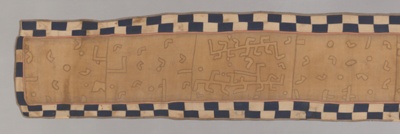
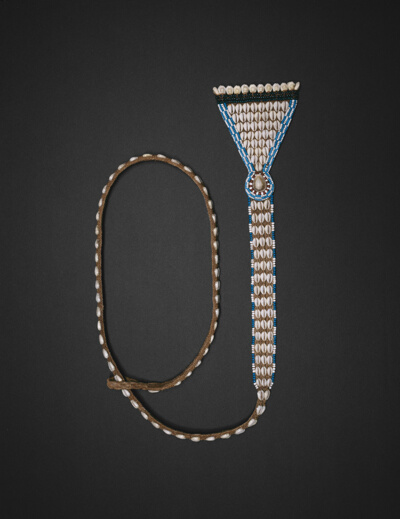
Kuba ceremonial skirts such as this one were worn as part of everyday finery by figures of high social rank as well as exchanged or otherwise distributed as prized items or currency; the objects were also sometimes used in dowry payments or displayed as funerary shrouds. The production of a fabric from the raffia palm leaf requires intensive human labor and technical ability. The abstract motifs that overlay the raffia cloth—circles, L-shapes, and lozenges—reference symbols and ideas that were broadly understood by the Kuba. The interlacing grid-like sections with their tight compositional style contrast sharply with the looser configuration of abstract elements in the center. Simple shapes are scattered—sparsely in places and densely in others—over panels of finely woven, undyed raffia. Although the placement of the shapes is often determined by small holes or tears in the raffia fabric, the shapes themselves and the way they interact imply a conscious attempt to enhance aesthetic appeal through compositional configurations.
미술관이 쓴 설명 원문입니다(영어). 라이선스: CC BY 4.0
작품 이미지와 미술관 정보를 이 기기에 저장해 인터넷 연결 없이 읽어 보세요.
궁금한 것을 내 말로 물어보세요. 미술관이 이 작품에 대해 쓴 글에서 답을 찾고, 거기에 없으면 없다고 말합니다.
이미지: Art Institute of Chicago, CC0