잠시만 기다려 주세요
잠시만 기다려 주세요
작품의 주요 특징과 배경을 연결해 살펴봐요.
가이드를 찾고 있습니다.
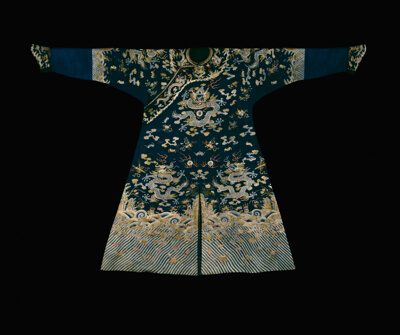
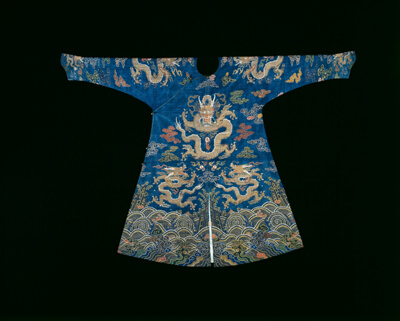
Some of the stylistic elements of this nineteenth-century jifu, such as the shaped overlap at the front, lower sleeves, and horse-hoof-shaped cuffs, emphasize Manchu forms and construction details. Overall, however, the eighteenth-century restyling which influenced this garment's design was linked to Chinese imperial precedent and reflected Han-Chinese tastes and aesthetics. During the re-evaluation of court attire initiated by the Qianlong emperor in 1748, this robe type, which had previously been called longpao, or "dragon robe," was renamed jifu, or "auspicious robe." This new name reflected Han-Chinese precedent, as it is a reference to a name for court garments that appeared in the Zhouli (Rituals of [the] Zhou [dynasty]). Its addition exemplifies the conscious reshaping of the Qing imperial image. Although by the 1650s the court had reserved minghuang (bright yellow) for the use of the emperor and his principal consort, ritual obligations often demanded that the royal couple wear different colors. Blue chaofu for exmaple were worn for the rites held during the winter solstice at the Alar of Heaven, located south of the Forbidden City. Semi-formal court garments like this rare, all-blue tapestry-wovern jifu were probably worn during the three-day period of fasting and purification that preceded the sacrifices. --John E. Vollmer, Clothed to Rule the Universe: Ming and Qing Dynasty Textiles at the Art Institute of Chicago (2000): 35-36, plate xv, cat. 28.
미술관이 쓴 설명 원문입니다(영어). 라이선스: CC BY 4.0
작품 이미지와 미술관 정보를 이 기기에 저장해 인터넷 연결 없이 읽어 보세요.
궁금한 것을 내 말로 물어보세요. 미술관이 이 작품에 대해 쓴 글에서 답을 찾고, 거기에 없으면 없다고 말합니다.
이미지: Art Institute of Chicago, CC0