잠시만 기다려 주세요
잠시만 기다려 주세요
가이드를 찾고 있습니다.
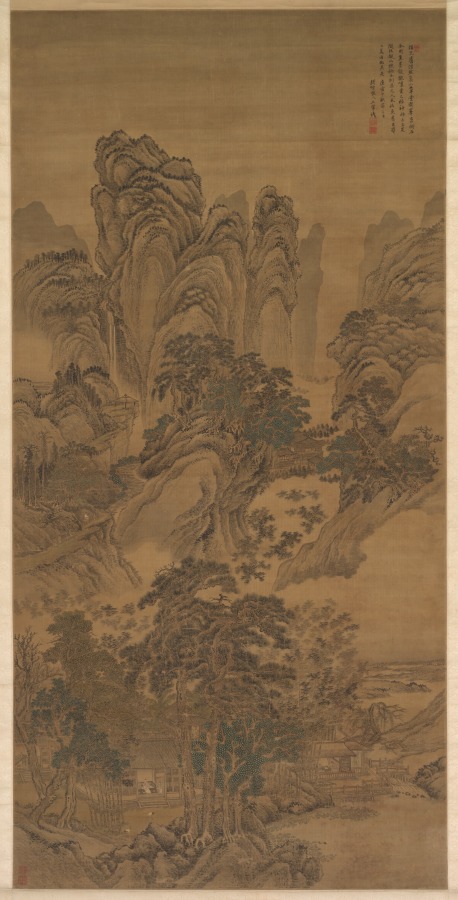
Wang Hui 王翬, a leading painter in the orthodox school of the early Qing dynasty (1644–1911), was commissioned to paint this landscape with a country estate for Li Duna 勵杜納 (1628–1703), vice minister of justice in Emperor Kangxi’s court. The emperor had honored Li by granting him a piece of calligraphy with the name of Li’s retirement retreat, “Hall of Lofty Pines.” He drew a comparison between pines and Li’s upright character, resilience, and longevity. Wang Hui’s painting was supposed to allow Li to imagine living in a beautiful, secluded compound among the hills and pines. Sadly, Li died before seeing the completed painting and before receiving the emperor’s permission to retire. The landscape begins with peaceful riverbanks and low hills. The pines around the estate in the middle of the handscroll are truly lofty, some stretching even beyond the frame of the painting. Li Duna, the estate’s owner, is shown twice in his serene mountain retreat: first approaching the entrance to the compound with two servants at the right, and then later in the scroll, to the left, reading in the comfort of an inner room. One servant carries the estate owner's carefully wrapped qin, a type of zither.
미술관이 쓴 설명 원문입니다(영어). 라이선스: CC0
작품 이미지와 미술관 정보를 이 기기에 저장해 인터넷 연결 없이 읽어 보세요.
궁금한 것을 내 말로 물어보세요. 미술관이 이 작품에 대해 쓴 글에서 답을 찾고, 거기에 없으면 없다고 말합니다.
이미지: Cleveland Museum of Art, CC0