잠시만 기다려 주세요
잠시만 기다려 주세요
작품의 주요 특징과 배경을 연결해 살펴봐요.
가이드를 찾고 있습니다.
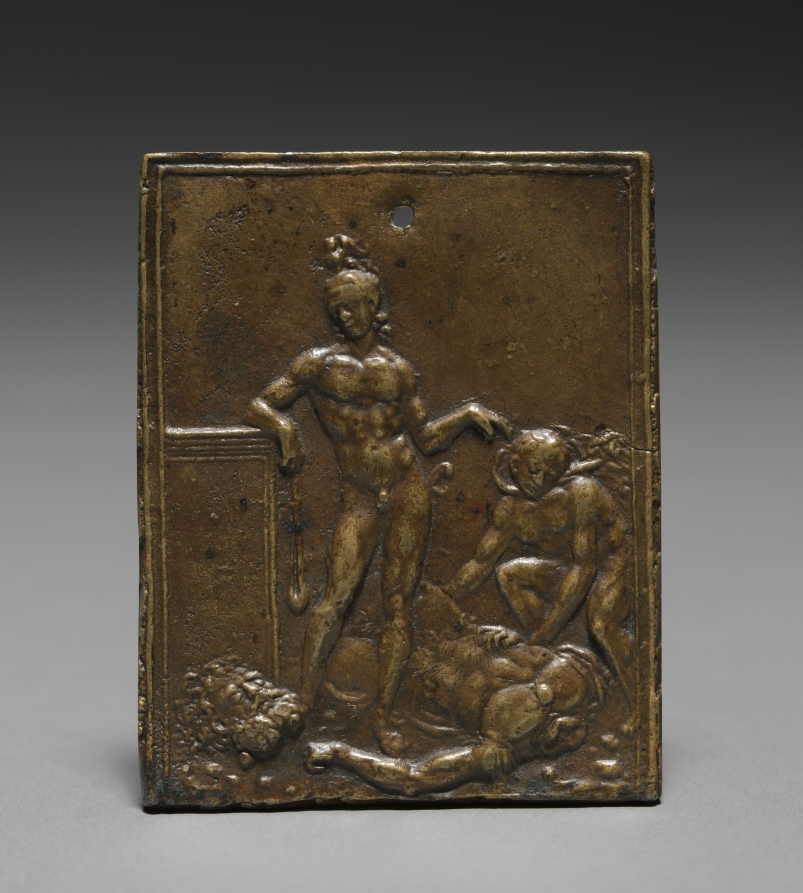
This plaquette by Moderno, a Northern Italian sculptor active in the early 1500s, displays the ancient subject of Hercules wrestling the Nemean lion. The subject of this plaquette finds its origins in the ancient myth of the Twelve Labors of Hercules, a popular theme during the Renaissance. After killing his wife and child in a fit of rage, Hercules was sent by an oracle to be punished by King Eurystheus of Tiryns. The King presented Hercules with twelve challenges, the first of which was to kill the Nemean lion. Twice as large as a normal lion, it had an impenetrable hide, symbolic of the uncontrollability of nature. Hercules tracked the lion to its cave, and after failing to kill it with the arrows of Apollo, Hercules strangled the lion with his bare hands. As Hercules' strength allowed him to defeat the lion, the myth expresses human dominance over nature. Hercules then used the lion's razor-sharp claws to remove its skin and returned to King Eurystheus wearing the impenetrable skin as protection. To honor the lion's struggle against Hercules, Zeus transformed the lion into the constellation Leo. In this scene, the nude Hercules stands in profile facing left with his left foot resting on the plaquette's lower border. The plaquette has no background other than a barren tree against which rest Hercules's club and Apollo's quiver and bow. The lion rests its rear paw on Hercules' thigh as Hercules lifts the lion off of the ground. The lion's body and mane consists of stylized tufts of fur which contrast with the smooth, naturalistic form of Hercules' body. The minute, short curling lines of the hair and mane create a rhythmic effect while the smooth curves of the forms place an emphasis on contour-this contrast of visual rhythm with smooth form is in fact characteristic of Moderno's bronze relief sculpture. The composition meanwhile has its origin in ancient Greek coins as well as Renaissance cameos.
미술관이 쓴 설명 원문입니다(영어). 라이선스: CC0
작품 이미지와 미술관 정보를 이 기기에 저장해 인터넷 연결 없이 읽어 보세요.
궁금한 것을 내 말로 물어보세요. 미술관이 이 작품에 대해 쓴 글에서 답을 찾고, 거기에 없으면 없다고 말합니다.
이미지: Cleveland Museum of Art, CC0