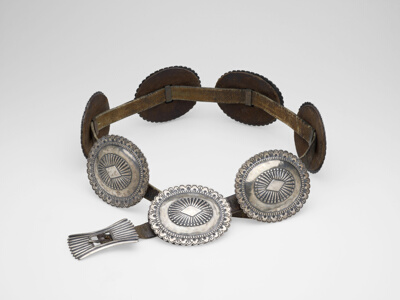
Horse Headstall
Navajo (Diné) · 1870s · 시카고 미술관
가이드
가이드 조절처음 · 보통
가이드를 찾고 있습니다.
미술관의 설명
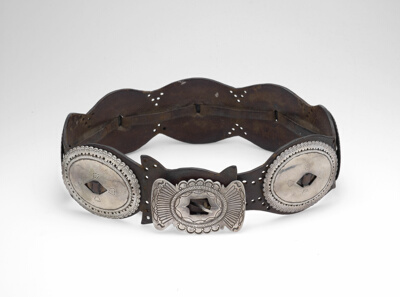
During the 1860s and early 1870s, Navajo (or Diné) communities learned silversmithing from Hispanic artists in New Mexico, as well as from Native artists from Plains communities, whose own metalworking traditions stemmed from Colonial sources in the eastern United States. Mexican pesos, U.S. American dollars, and ingot silver were melted down and recast in molds carved from soft volcanic tufa. Navajo silversmiths employed steel tools and punches to develop decorative patterns. Early concho belts, bow guards, bracelets, necklaces, horse headstalls, and other items of silver jewelry display massive forms and simple ornamentation. By the 1890s turquoise was increasingly used; although most turquoise was obtained from Southwestern sources, some was imported from China and Iran. Navajo silversmiths rapidly established a distinctive elegant style that has become one of the classic hallmarks of Native American art in the greater Southwest. Today, Navajo jewelry, like that of their neighboring Pueblo neighbors, exhibit much greater complexity of design and the use of diverse semiprecious stones, shell, and a variety of metals.
미술관이 쓴 설명 원문입니다(영어). 라이선스: CC BY 4.0
이 작품, 어땠나요?
작품 이미지와 미술관 정보를 이 기기에 저장해 인터넷 연결 없이 읽어 보세요.
이 작품에 대해 묻기
궁금한 것을 내 말로 물어보세요. 미술관이 이 작품에 대해 쓴 글에서 답을 찾고, 거기에 없으면 없다고 말합니다.
작품 정보
- 작가
- Artist unknown (Navajo, Diné), Northern New Mexico or Arizona
- 제작 시기
- 1870s
- 재료
- Silver and leather
- 크기
- Approx: H.: 61 cm (24 in.)
- 제작 지역
- New Mexico
- 소장처
- 시카고 미술관, Chicago · 지금은 전시하지 않음
- 소장 경위
- Purchased with funds provided by Mrs. Muriel Kallis Newman in honor of Kathy Cottong, equestrian and Director of the Arts Club
이미지: Art Institute of Chicago, CC0