잠시만 기다려 주세요
잠시만 기다려 주세요
Kyūseki Tomonobu · late 1600s–early 1700s · 클리블랜드 미술관
작품의 주요 특징과 배경을 연결해 살펴봐요.
가이드를 찾고 있습니다.
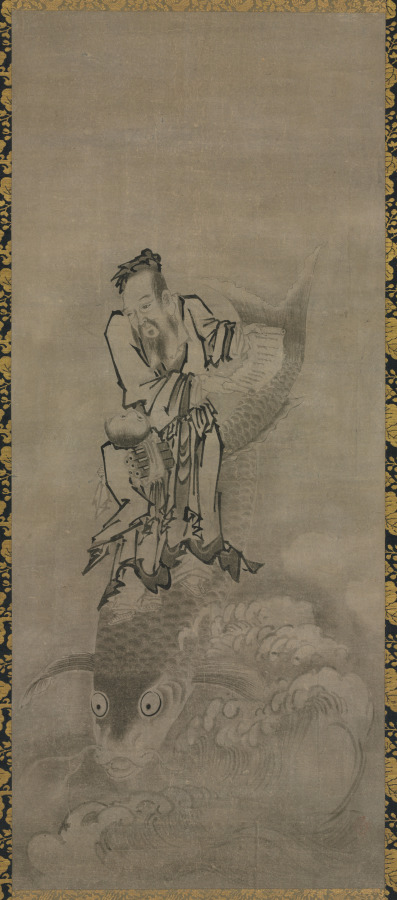
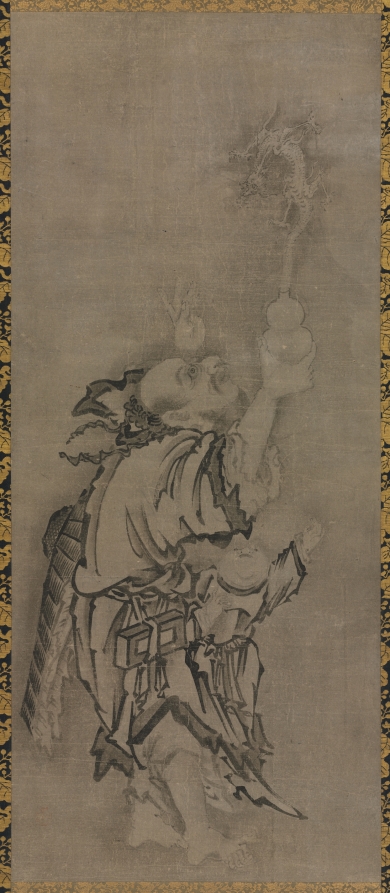
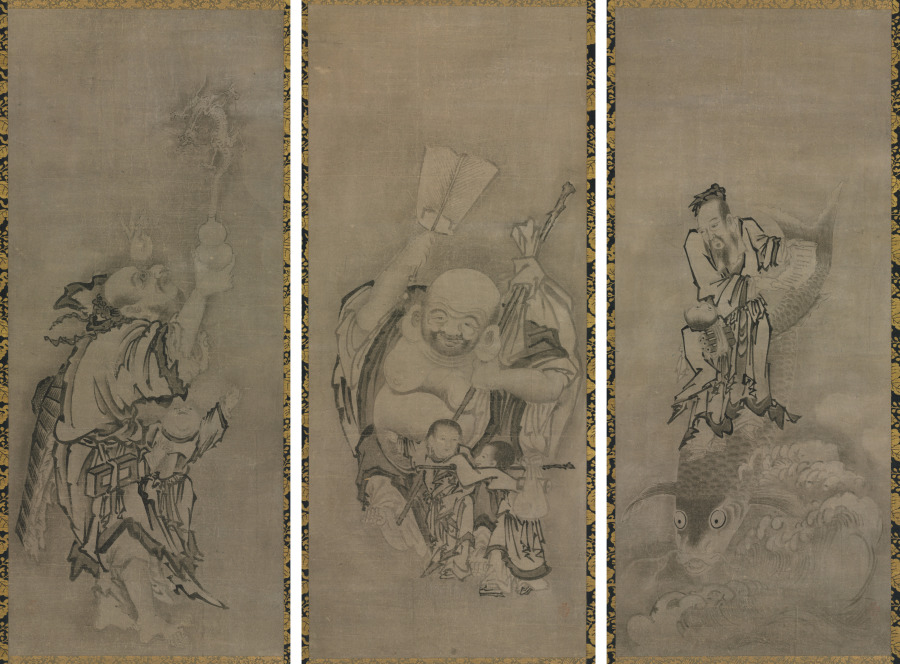
Hotei was a Chan (Japanese: Zen) monk living in China during the 900s who, in the 1300s, became a legendary figure in Japan. At that time a popular cult praising him sprang up, extending beyond Zen to other religious communities. This rare triptych embraces a central Zen icon with flanking Daoist images, thereby suggesting the compatibility-rather than the exclusivity-of these two creeds. Hotei also enjoys popularity in Japan as a kind of genre, or folk figure, which explains his mirthful expression in Japanese paintings. The Daoist figures in contrast appear eccentric and foreign-looking, in keeping with Daoist lore. When these paintings came to the museum their appearance was compromised by poor quality textile mountings, and cracked paper surfaces deserving of restoration. The fact that these scrolls constituted an integral set that properly had to be shown as a unit heightened the need to stabilize their condition and improve their presentation for museum visitors. A complete remounting of each scroll occurred following the cleaning of the paper surfaces and the repair of the lifting surface areas. No inpainting was done, thereby preserving the original ink values and brushstrokes.
미술관이 쓴 설명 원문입니다(영어). 라이선스: CC0
작품 이미지와 미술관 정보를 이 기기에 저장해 인터넷 연결 없이 읽어 보세요.
궁금한 것을 내 말로 물어보세요. 미술관이 이 작품에 대해 쓴 글에서 답을 찾고, 거기에 없으면 없다고 말합니다.
이미지: Cleveland Museum of Art, CC0