잠시만 기다려 주세요
잠시만 기다려 주세요
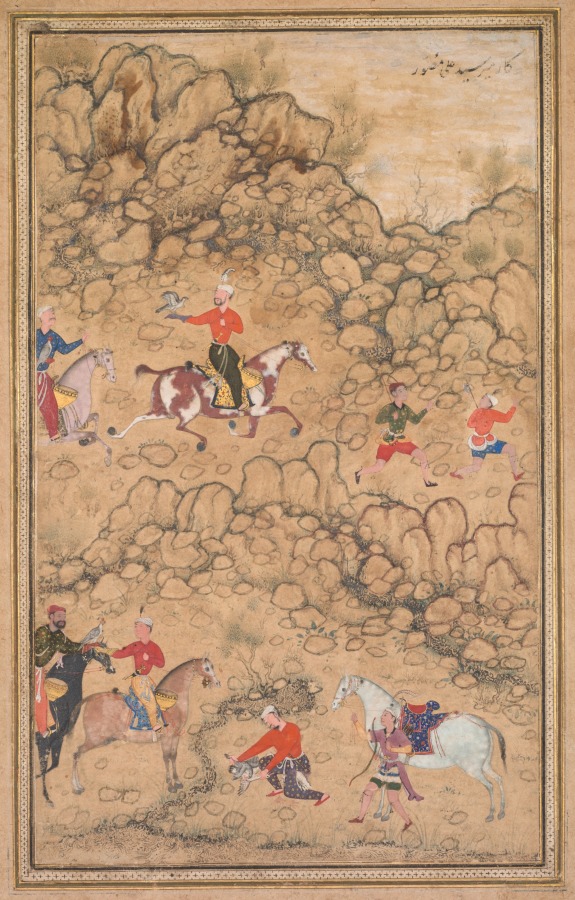
Abd al-Samad · c. 1558–60; borders added probably 1700s · 클리블랜드 미술관
작품의 주요 특징과 배경을 연결해 살펴봐요.
가이드를 찾고 있습니다.
The Mughals hunted on horseback with falcons. The hunting party would ride out into the wild and flush the prey. Then, its hood removed, the falcon would chase the prey and bring it down. From childhood Akbar loved hunting, and this painting may be a rare depiction of Akbar as a youth at the lower left, with the black feather in his white turban. The falcon that has caught a duck has been hooded and is being passed between the young man and his bearded companion. This important work was painted by one of the Persian artists Akbar’s father brought to India from Iran. The inscription at the upper right gives the name of one of the other Persian artists, but it is probably an erroneous later addition. This page of delicately illuminated calligraphy from the pre-Mughal period was mounted into a Mughal album. The poems are written in the native language of the Mughals, a form of Turkish called Chaghatai, using a flowing form of Arabic script called nasta‘liq. The Mughals self-consciously adopted Persian as their official court language, so few Chaghatai books or works of calligraphy were made for them. The quatrain in the center reads: The wine has made an attempt on my life, Since it is the wine that can wear down the pain of separation. O Sufi! Let the mosque be for you, and the tavern for me, Since you need to arrive at the Spring of Kowsar, while I am in need of wine! The Spring of Kowsar is where the righteous quench their thirst in the afterlife. The hunter’s glove is on the ground, as he pulls his falcon off the duck.
미술관이 쓴 설명 원문입니다(영어). 라이선스: CC0
작품 이미지와 미술관 정보를 이 기기에 저장해 인터넷 연결 없이 읽어 보세요.
궁금한 것을 내 말로 물어보세요. 미술관이 이 작품에 대해 쓴 글에서 답을 찾고, 거기에 없으면 없다고 말합니다.
이미지: Cleveland Museum of Art, CC0