잠시만 기다려 주세요
잠시만 기다려 주세요
Ancient Etruscan · 3rd century BCE · 시카고 미술관
작품의 주요 특징과 배경을 연결해 살펴봐요.
가이드를 찾고 있습니다.
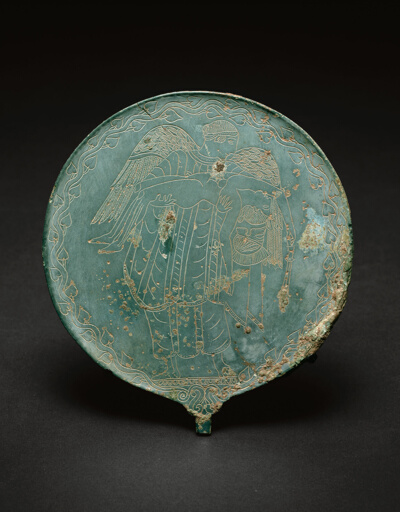
In Etruria, bronze mirrors were luxury objects designed primarily for women, who were buried with them for use in the afterlife. The front of the bronze disk would have been highly polished in order to reflect the viewer’s image. This example has a handle in the form of a winged Lasa, a minor deity associated with Turan, the Etruscan goddess of love. Lasa holds an alabastron (container for scented oil) in her left hand. Because Lasa is thought to have been associated with funerary rites, the alabastron might evoke the ceremonial anointing of the dead. An image of Eros, the god of love, is engraved on the back of this reflective disk. Eros was a fitting subject for bronze mirrors, which were given primarily to women, likely as wedding presents. Here, with hammer firmly in hand, Eros stands among carpentry tools, including a second hammer, an adze, a double axe, a chisel, and possibly a double saw. On the left is an amphora (storage jar) and a table. The significance of this unusual scene is not yet understood, but its selection might reflect the Etruscan taste for obscure and rarely illustrated mythological episodes.
미술관이 쓴 설명 원문입니다(영어). 라이선스: CC BY 4.0
작품 이미지와 미술관 정보를 이 기기에 저장해 인터넷 연결 없이 읽어 보세요.
궁금한 것을 내 말로 물어보세요. 미술관이 이 작품에 대해 쓴 글에서 답을 찾고, 거기에 없으면 없다고 말합니다.
이미지: Art Institute of Chicago, CC0