잠시만 기다려 주세요
잠시만 기다려 주세요
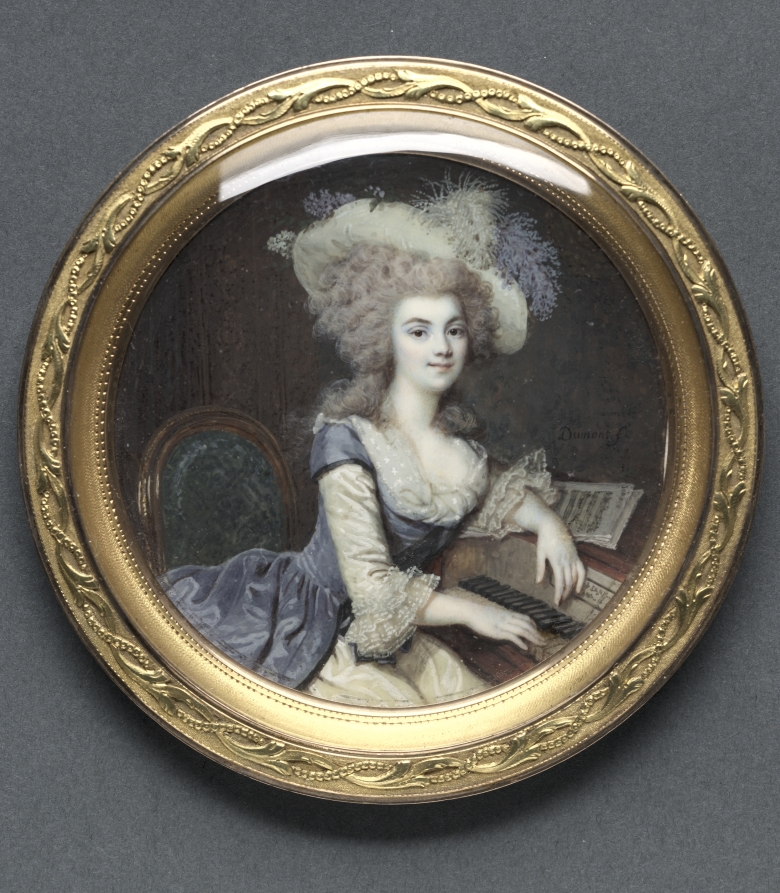
François Dumont · 1804 · 클리블랜드 미술관
작품의 주요 특징과 배경을 연결해 살펴봐요.
가이드를 찾고 있습니다.
Born in 1744, Anne Vallayer-Coster was a prominent still-life painter in France during the 1770s and 1780s. The daughter of a goldsmith, she grew up observing the intricacies of metalwork, acquiring an attention to detail apparent in her paintings. She was apprenticed to the seascape painter Joseph Vernet who encouraged her to pursue painting as a profession. In 1770 Vallayer-Coster sought membership in the exclusive French Académie Royale de Peinture et de Sculpture with the submission of two still-life paintings, "The Attributes of Painting, Sculpture, and Architecture" and "The Attributes of Music." She was accepted with full rights and privileges to the overwhelmingly male academy-the only woman to be granted membership during this period independent of royal support or ties to a male academician. Denis Diderot, a French art critic and philosopher, responded to her submissions: "It is certain that if all new members made a showing like Mademoiselle Vallayer's, and sustained the same high level of quality there, the Salon would look very different!" Since women were officially barred during the 18th century from studying the male nude from life, still-life painting was among the few genres open to female painters. Garnering a reputation as a beautiful socialite who possessed the painting skills usually ascribed to male history painters, she was the only woman to enjoy the honor of lodging in the Louvre under the invitation of Marie Antoinette, who greatly admired her work. Marie Antoinette herself was present at the artist's 1781 marriage to Jean-Pierre-Silvestre Coster in the halls of Versailles. Despite the close associations with Antoinette and her administration, Vallayer-Coster survived the French Revolution of 1789 and the Reign of Terror in 1793. Many of her patrons were not so fortunate, and the artist's production virtually stopped until 1804, when François Dumont painted this miniature. During this period, Vallayer-Coster struggled to reestablish herself among the elite of Paris. Over the course of 1804, she exhibited two works at the Salon and had two works commissioned by Empress Josephine de Beauharnais. Dumont's miniature depicts Vallayer-Coster holding a paintbrush in her right hand and a vase with flowers in her left, clearly an allusion to her skill as a still-life painter. Perhaps Vallayer-Coster requested that Dumont portray her as an artist in order to reassert her status as an important still-life painter. She may have intended to give the miniature to the empress in gratitude for her commissions and in the hope that there would be more to come. Her last major work, "Still Life with Lobster", was given to Louis XVIII and displayed at the Salon in 1817. Vallayer-Coster died in 1818 at the age of 74. Dumont worked closely with Marie Antoinette and, like Vallayer-Coster, grappled with diminished patronage after the queen's death and years of revolution. He attempted to reestablish his practice during the reigns of the Bourbon kings Louis XVIII and Charles X, but the competition provided by miniaturists like Jean-Baptiste Isabey (1767-1855) proved too strong. Dumont's exquisite portrait of Vallayer-Coster was produced during a time when both artist and sitter had fallen from the limelight and were struggling to prove their enduring relevance in the new regime. Ashley Bartman (May 2014)
작품 이미지와 미술관 정보를 이 기기에 저장해 인터넷 연결 없이 읽어 보세요.
궁금한 것을 내 말로 물어보세요. 미술관이 이 작품에 대해 쓴 글에서 답을 찾고, 거기에 없으면 없다고 말합니다.
이미지: Cleveland Museum of Art, CC0
미술관이 쓴 설명 원문입니다(영어). 라이선스: CC0