잠시만 기다려 주세요
잠시만 기다려 주세요
John I Smart · 1799 · 클리블랜드 미술관
작품의 주요 특징과 배경을 연결해 살펴봐요.
가이드를 찾고 있습니다.
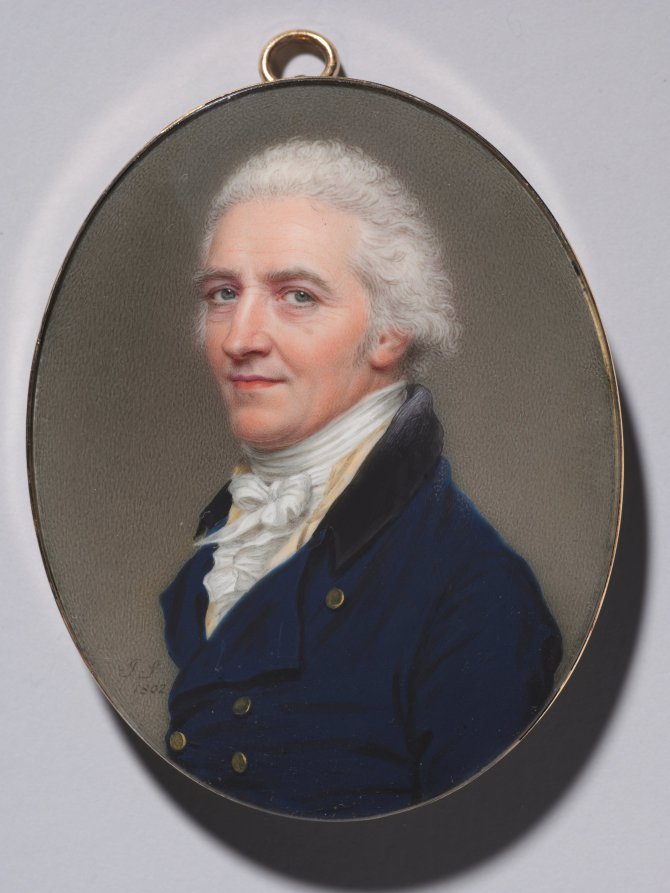
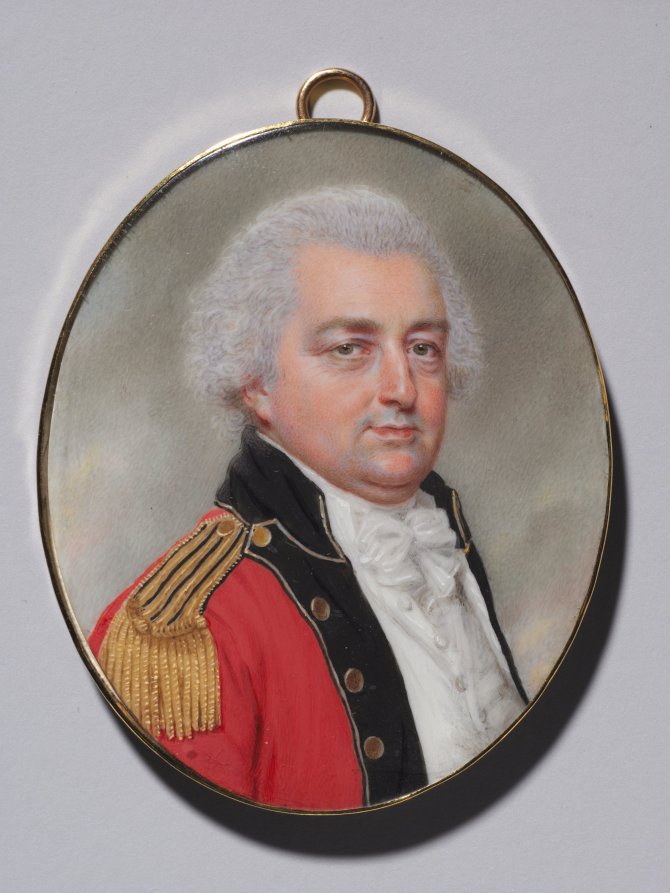
Daniel Burr (1750–1828) is depicted here as colonel of the 10th Madras Native Infantry. He joined the East India Company in 1767 as a cadet, became an ensign in 1768, a colonel in 1797, and achieved the rank of major general in 1805. The work is signed and dated “JS / 1799,” indicating that John Smart painted Burr while the officer was back in England on furlough between July 30, 1798, and April 2, 1799. Diarist Joseph Farington noted in 1798 that Smart was charging 25 guineas for his portrait miniatures and making from £500 to £600 a year. By comparison, George Engleheart (1752–1829) during this period was charging 12 to 15 guineas for his portrait miniatures, and even in the 1780s, Richard Cosway (1742–1821) was known to charge between 20 and 30 guineas. This work was exhibited at the Royal Academy in 1799 (no. 784) as “Portrait of Colonel Burr.” It was formerly in the collection of Benjamin Nathan, a wealthy London goldsmith and diamond dealer whose heirs did not wish to retain the miniature and sold it upon his death. Here, Daniel Burr has a ruddy complexion, gray hair, and brown eyes. He wears a red military coat, with dull orange velvet facings, over a jabot with a high white collar and frills. On his left shoulder is a white, fringed epaulet with two gold stars. The background is mottled gray. The miniature is housed in a gold frame with a gold monogram DB and an arrangement of dark brown hair in a medallion on the back. At slightly over 3 inches, this miniature is larger than was customary for Smart during his time in India; it was obviously painted later, when Smart and the officer had returned to England. Smart also painted the miniature portrait of Burr’s first wife, Lucy (née Parry). A second portrait of Burr was executed by Smart in 1803 and sold at Christie’s, London, in 2009. This version is signed with initials and dated: “JS / 1803.” Burr’s hair is worn à l’antique, and his uniform includes a gold epaulet with two star rank badges and the Honourable East India Company’s coat of arms. Burr occupied the rank of colonel in both the 1799 and 1803 portraits, but the uniform differs in the latter because in 1801 the facings of the 10th Madras Native Infantry uniform were altered to red, and rank badges were added to the now gold epaulets. Curiously, Burr appears younger in the 1803 portrait than in the 1799 version, in which his crow’s feet and sagging jowls are more pronounced. The 1803 portrait of Burr was exhibited at the Royal Academy in 1811 (no. 637), the year Smart died. A sketch after Smart of Burr was executed by R. Greaves, and a three-quarter length portrait by Sir Martin Archer Shee was exhibited at the Royal Academy in 1825 (no. 146). The verso or back side contains gilt initials DB and an intricate pattern of braided hair.
미술관이 쓴 설명 원문입니다(영어). 라이선스: CC0
작품 이미지와 미술관 정보를 이 기기에 저장해 인터넷 연결 없이 읽어 보세요.
궁금한 것을 내 말로 물어보세요. 미술관이 이 작품에 대해 쓴 글에서 답을 찾고, 거기에 없으면 없다고 말합니다.
이미지: Cleveland Museum of Art, CC0