잠시만 기다려 주세요
잠시만 기다려 주세요
작품의 주요 특징과 배경을 연결해 살펴봐요.
가이드를 찾고 있습니다.
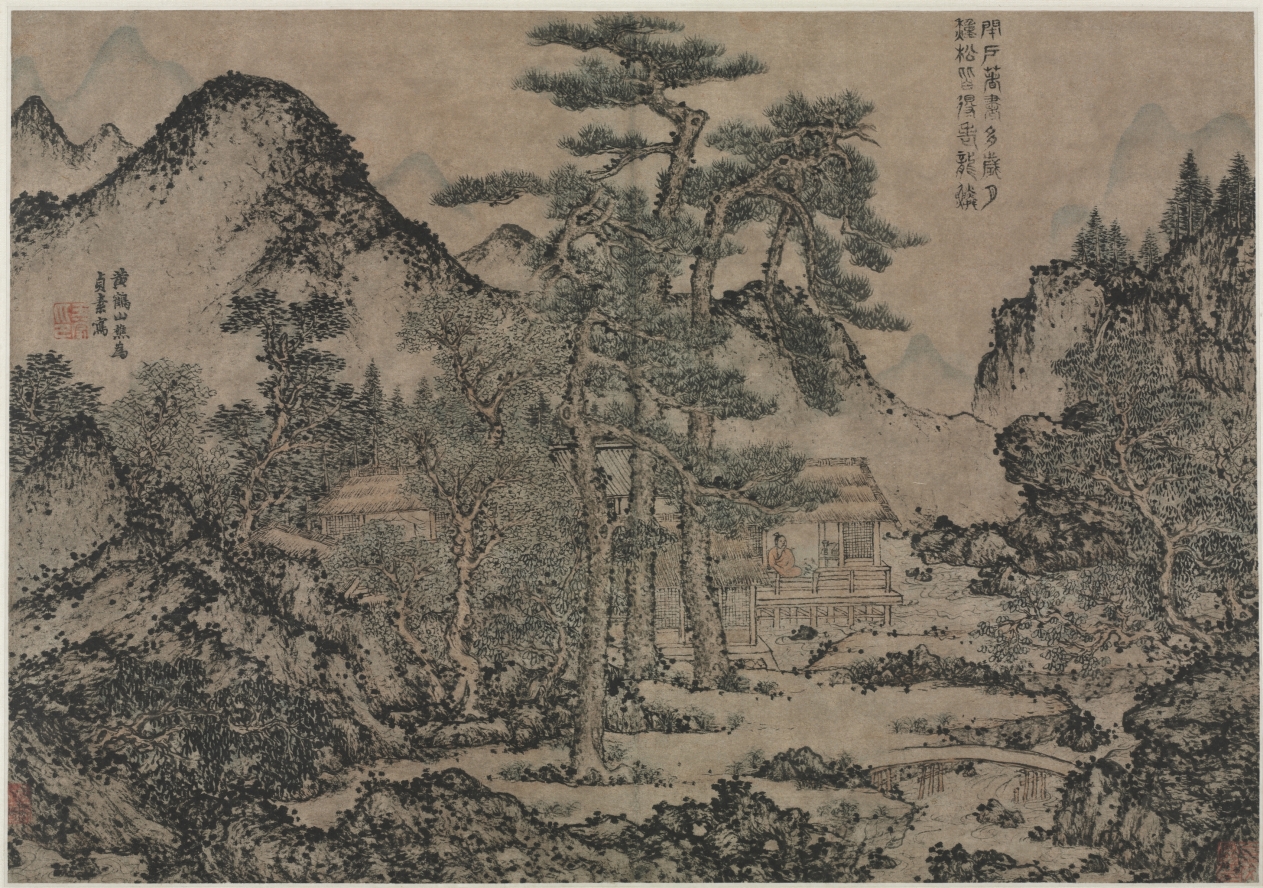
This modest cottage nestled at the foot of towering mountains presents a quintessential image of academic retreat from the “dusty” world of material concerns and political instabilities. Its cultured occupant kneels on a platform and plays the zither (qin); a book lies open before him and young servants wait attentively nearby. The luxuriant setting of layered peaks and intertwined trees, as well as the dry, charcoal- like treatment of fibrous and dotted boulders, is imbued with a textural richness. This style is closely associated with Wang Meng, the last of the “Four Great Masters” of the Yuan dynasty. Such a complex, kinetic composition reflects this artist's distinctive contribution to the literati's new use of painting as a vehicle for intellectual and emotional self-expression. This concept was largely kindled by social and political upheavals that accompanied the 14th-century Mongol conquest of China and the establishment of the Yuan dynasty. Wang Meng, who had served the Mongol government as a legal scribe, retired to a mountain hermitage in the turbulent final decades of Yuan rule. He may have executed this painting as a metaphorical self-portrait.
미술관이 쓴 설명 원문입니다(영어). 라이선스: CC BY 4.0
작품 이미지와 미술관 정보를 이 기기에 저장해 인터넷 연결 없이 읽어 보세요.
궁금한 것을 내 말로 물어보세요. 미술관이 이 작품에 대해 쓴 글에서 답을 찾고, 거기에 없으면 없다고 말합니다.
이미지: Art Institute of Chicago, CC0