잠시만 기다려 주세요
잠시만 기다려 주세요
작품의 주요 특징과 배경을 연결해 살펴봐요.
가이드를 찾고 있습니다.
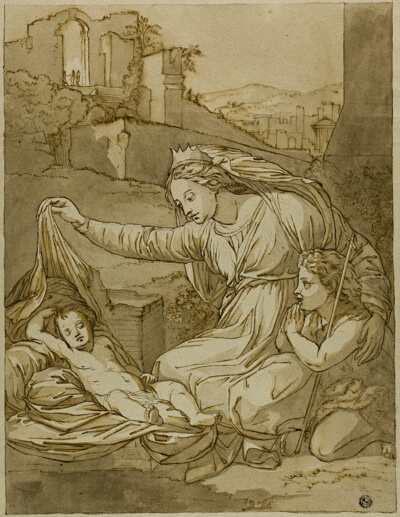
This drawing comes from Raphael’s "pink sketchbook," a set of ten roughly equal sheets, each portraying variations of a mother and child. Today, six of the drawings are at the Palais des Beaux-Arts, Lille; two are at the British Museum; one is in a private collection; and one is in Cleveland. The small format of the sheets would have enabled the artist to take the sketchbook with him as he traveled from Florence to Rome around 1508. Raphael used metalpoint on paper prepared with a pink surface, a technique popular in 15th- and early 16th-century Italy. The sheet includes one of Raphael's earliest studies after a nude female model, who is seated on the ground and wears a turban. The infant's head in the drawing was based on that of the Christ child in Leonardo da Vinci's Benois Madonna, then in a private collection in Florence, with changes—such as the uplifted eyes and open mouth—made by Raphael. The three sketches of a reclining infant at the bottom of the sheet are freely handled and improvisational, relaying the child's squirming, continuous movement with repeated contour lines. Raphael later used a similar pose for the Christ child in a painting of the Holy Family (The Madonna of the Veil, c. 1511, Musée Condé, Chantilly). The Renaissance drawing technique of metalpoint employed a stylus of soft metal that left a mark when applied to a specially prepared sheet coated with ground eggshell, powdered bone, or lead white. It required great skill, as it was impossible to erase or efface.
미술관이 쓴 설명 원문입니다(영어). 라이선스: CC0
작품 이미지와 미술관 정보를 이 기기에 저장해 인터넷 연결 없이 읽어 보세요.
궁금한 것을 내 말로 물어보세요. 미술관이 이 작품에 대해 쓴 글에서 답을 찾고, 거기에 없으면 없다고 말합니다.
이미지: Cleveland Museum of Art, CC0