잠시만 기다려 주세요
잠시만 기다려 주세요
Ancient Greek · Reign of Phillip II (359–336 BCE) · 시카고 미술관
작품의 주요 특징과 배경을 연결해 살펴봐요.
가이드를 찾고 있습니다.
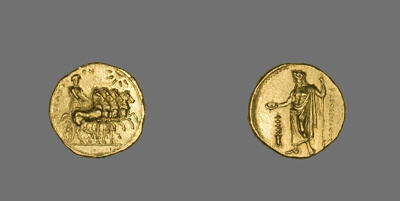
The official record of quadrennial games honoring the supreme Greek god Zeus at a sanctuary dedicated to him at Olympia began in 776 BCE. With few interruptions, they took place every four years for about 1,100 years. In 394, CE the Christian emperor Theodosius I (reigned 379–95) abolished them as pagan rites. The most prestigious competition remained the footrace, but eventually it was supplanted in popularity by the horse races. Horses were symbols of socioeconomic status, since only the privileged could afford to buy, feed, and train them and transport their teams and trainers to Olympia every four years. In time, many of the victors in the horse races included kings and tyrants. Philip II, king of Macedon, who minted this coin, owned the horse that won the race in Olympia in 356 BCE. The same year his son was born; he would grow up to become Alexander the Great (356–332 BCE). The head of Zeus on the front referred to Philip's claim that his family descended from the god. On the back Philip commemorated his victory in the horse races of the Olympic Games with an image of a jockey astride his mount.
미술관이 쓴 설명 원문입니다(영어). 라이선스: CC BY 4.0
작품 이미지와 미술관 정보를 이 기기에 저장해 인터넷 연결 없이 읽어 보세요.
궁금한 것을 내 말로 물어보세요. 미술관이 이 작품에 대해 쓴 글에서 답을 찾고, 거기에 없으면 없다고 말합니다.
이미지: Art Institute of Chicago, CC0