잠시만 기다려 주세요
잠시만 기다려 주세요
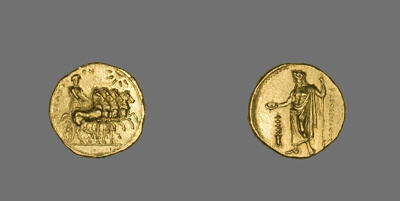
Ancient Greek · 297-281 BCE, issued by King Lysimachus of Thrace (306–281 BCE) · 시카고 미술관
작품의 주요 특징과 배경을 연결해 살펴봐요.
가이드를 찾고 있습니다.
The Hellenistic period spans the nearly three hundred years between the death of Alexander the Great of Macedonia (323 BCE) and that of Cleopatra VII of Egypt (30 BCE), a descendant of one of Alexander’s generals. The term Hellenistic is derived from Hellas, an ancient Greek word for Greece. It is used to describe both chronologically and culturally the era following Alexander’s conquest of Egypt and Asia, which resulted in the spread of Greek culture across a vast area. The melding of local and Greek artistic styles with the luxurious materials captured in the conquered lands resulted in magnificent artwork, including elegant coinage. Following Alexander’s death, his empire was divided among his generals, who established independent kingdoms in Egypt; Persia; the eastern coast of the Aegean Sea, including Syria and Palestine; Greece and Macedonia; and Thrace. Almost immediately the generals began to covet each other’s land and power. Lysimachus (reigned 323–281 BCE), the general who succeeded Alexander as the ruler of Thrace, used the young ruler’s portrait on the front of this coin. However, on the back Lysimachus named himself “king” and pictured the goddesses Athena and Nike (Victory) crowning his name with laurels, which symbolized victory or honor. He also placed his personal badge—a lion’s fore-parts—under Athena’s hand. The badge referred to Lysimachus’s famous exploit of killing a lion with his bare hands, and reinforced his association with Alexander, who used the skin of the Nemean lion as one of his symbols of power and courage.
미술관이 쓴 설명 원문입니다(영어). 라이선스: CC BY 4.0
작품 이미지와 미술관 정보를 이 기기에 저장해 인터넷 연결 없이 읽어 보세요.
궁금한 것을 내 말로 물어보세요. 미술관이 이 작품에 대해 쓴 글에서 답을 찾고, 거기에 없으면 없다고 말합니다.
이미지: Art Institute of Chicago, CC0