잠시만 기다려 주세요
잠시만 기다려 주세요
가이드를 찾고 있습니다.
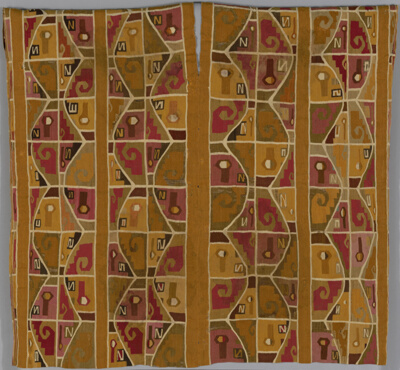
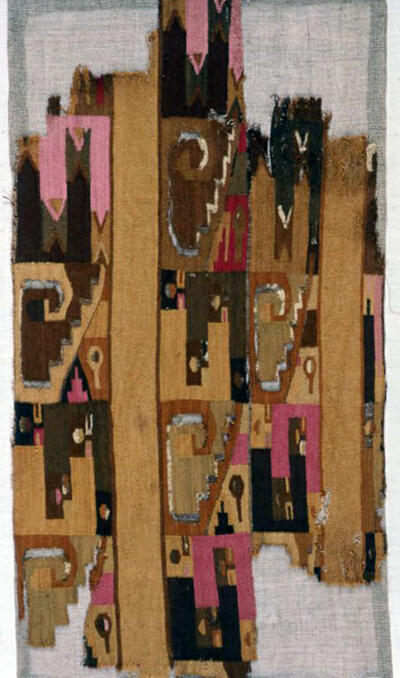
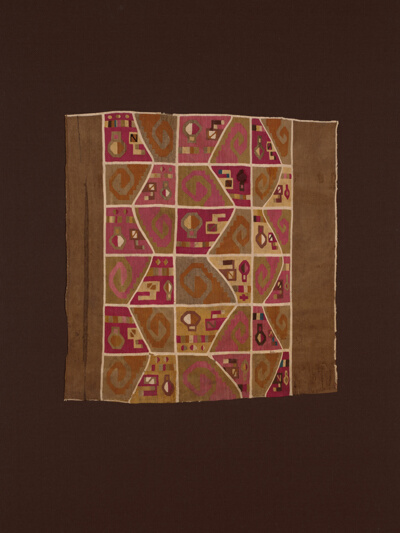
The Wari Empire rose to power near modern-day Ayacucho during the first millennium. Eventually, it came to control much of highland Peru alongside a related state called Tiwanaku in what is now Bolivia. Waris and Tiwanakus developed a shared corpus of imagery that was most elaborately materialized in fine tunics, which were then worn by and buried with elite men. Wari woven designs have some of the highest thread counts of any handwoven fabric made anywhere in the world. The designs on Wari tunics are highly abstract. One side of each motif is a zigzag line that turns into a spiral (a common but unclear Andean symbol), while the other half represents a face in profile. The vertically divided circle is the eye. The N-shaped area represents grimacing canine teeth. The band with two or three dots above or below it represents a hat. While the faces are clearer in the tunics to the left and right, in this fragment the eye is upside-down and the mouth is where the nose should be. Similar to other Wari textiles in the Art Institute's collection (including AIC 1955.1702, 1956.95), this tunic features motifs comprised of faces and stepped spirals, showing how highly regulated Wari designs were. But the most curious aspect of Wari tunics is how the compositions of the motifs become increasingly compressed on the garments’ sides.
미술관이 쓴 설명 원문입니다(영어). 라이선스: CC BY 4.0
작품 이미지와 미술관 정보를 이 기기에 저장해 인터넷 연결 없이 읽어 보세요.
궁금한 것을 내 말로 물어보세요. 미술관이 이 작품에 대해 쓴 글에서 답을 찾고, 거기에 없으면 없다고 말합니다.
이미지: Art Institute of Chicago, CC0