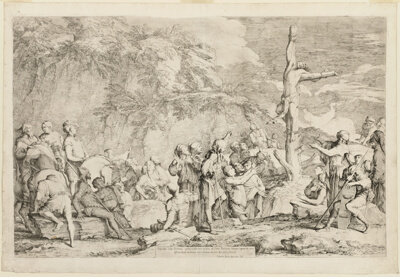
Ceres and Phytalus
Salvator Rosa · c. 1662 · Art Institute of Chicago
Guide
Adjust the guideNew to it · Medium
Looking for this guide.
From the museum
Salvator Rosa produced 17 large etchings in the early 1660s, frequently adopting mythological lore peppered with classical literature. Ceres and Phytalus deliciously celebrates the fig, of which Rosa was particularly fond. Phytalus, a king of Attica, is said to have given the goddess Ceres shelter on her journey to find her daughter Proserpina, whom Pluto had abducted into the underworld. Rosa’s inscription reads, “Here the hero Phytalus had received Ceres into his house, on whom she first bestowed the seeds of the sacred fruit which mortals call the FIG.” This honeyed crop subsequently became a staple of Mediterranean cuisine.
The museum’s own description, in English. Licence: CC BY 4.0
What did you think?
Save this work’s image and museum information on this device to read without a connection.
Ask about this work
Ask in your own words. The answer comes from what the museum has written about the work, and says so when that does not hold it.
Details
- Maker
- Salvator Rosa, Italian, 1615-1673
- Date
- c. 1662
- Medium
- Etching with drypoint in black on ivory laid paper
- Dimensions
- Image/plate: 35.2 × 23.6 cm (13 7/8 × 9 5/16 in.); Sheet: 46.4 × 33.6 cm (18 5/16 × 13 1/4 in.)
- Place of origin
- Italy
- Held by
- Art Institute of Chicago, Chicago · Not on view
- Credit line
- Gift of Pia Gallo in honor of Martha Tedeschi
Image: Art Institute of Chicago, CC0