
Just a moment
Just a moment
Guillaume-Benjamin-Amand Duchenne (de Boulogne) · c. 1856, printed 1862 · Cleveland Museum of Art
A closer look, connecting key details with the work’s background.
Looking for this guide.
Duchenne described this model, a former shoemaker, as “an old, toothless man, with a thin face, whose features, without being absolutely ugly, approached ordinary triviality.” When criticized for using such an unattractive model, Duchenne held him up as proof that “every human face could become spiritually beautiful through the accurate rendering of his or her emotions.” Duchenne, a neurologist at a hospital for the poor in Paris, turned to photography to record the grammar of human expression.
The museum’s own description, in English. Licence: CC0
Save this work’s image and museum information on this device to read without a connection.
Ask in your own words. The answer comes from what the museum has written about the work, and says so when that does not hold it.
Image: Cleveland Museum of Art, CC0
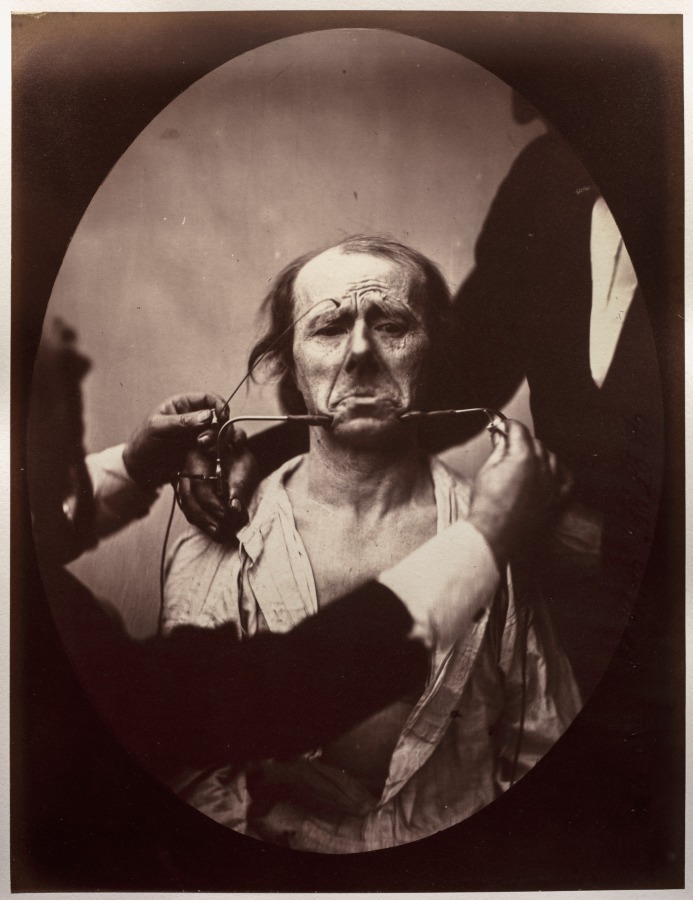 Figure 45: Contraction électrique forte des triangulaires des lèvres et des sourciliers: douleur et déspoirGuillaume-Benjamin-Amand Duchenne (de Boulogne) · c. 1856, printed 1862
 Figure 32: Natural laughter by the voluntary contraction of the two large zygomatics and the lower palpebral orbicularisGuillaume-Benjamin-Amand Duchenne (de Boulogne) · c. 1856, printed 1862
 Figure 7: Étude du méchanisme et de l'expression du muscle frontal chez un vieillard: à droit, attention; à gauche, reposGuillaume-Benjamin-Amand Duchenne (de Boulogne) · c. 1856, printed 1862
