
Just a moment
Just a moment
Guillaume-Benjamin-Amand Duchenne (de Boulogne) · c. 1856, printed 1862 · Cleveland Museum of Art
A closer look, connecting key details with the work’s background.
Looking for this guide.
Duchenne embarked on the first scientific, systematic exploration of the physiology of human facial expression and hoped, through photographs of his experiments, to teach artists how to portray those emotions. The experiments were performed by applying electrical stimulation to a single muscle on one side of the face, so that the viewer could clearly see the impact of the muscular contraction. Duchenne, a neurologist at a hospital for the poor in Paris, turned to photography to record the grammar of human expression.
The museum’s own description, in English. Licence: CC0
Save this work’s image and museum information on this device to read without a connection.
Ask in your own words. The answer comes from what the museum has written about the work, and says so when that does not hold it.
Image: Cleveland Museum of Art, CC0
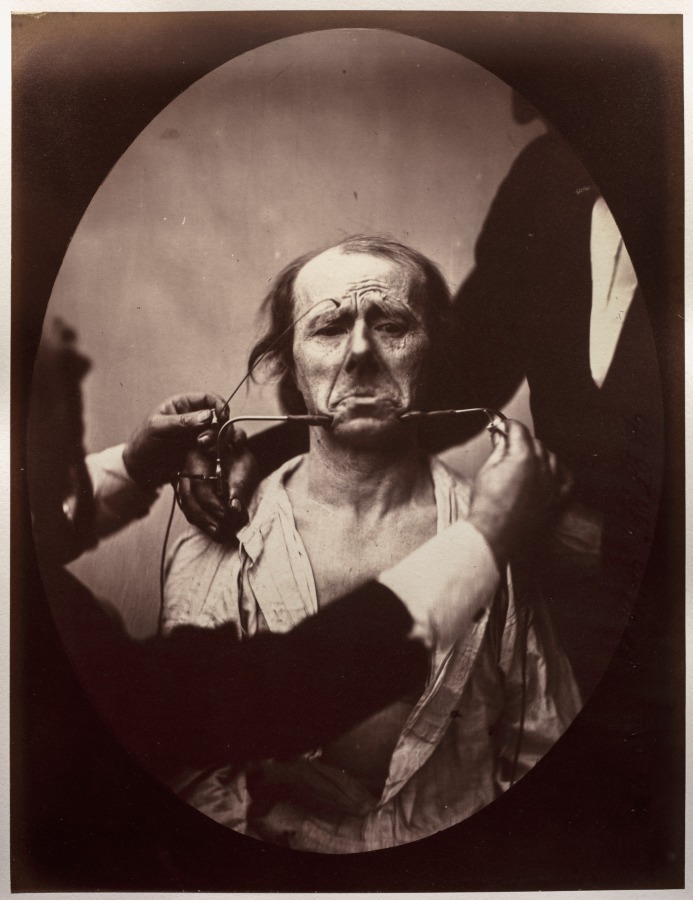 Figure 45: Contraction électrique forte des triangulaires des lèvres et des sourciliers: douleur et déspoirGuillaume-Benjamin-Amand Duchenne (de Boulogne) · c. 1856, printed 1862
 Figure 32: Natural laughter by the voluntary contraction of the two large zygomatics and the lower palpebral orbicularisGuillaume-Benjamin-Amand Duchenne (de Boulogne) · c. 1856, printed 1862
 Figure 54: Abaissement volontaire de la mâchoire inférieure: mouvement inexpressifGuillaume-Benjamin-Amand Duchenne (de Boulogne) · c. 1856, printed 1862
