Fireplace Surround
What did you think?
Save this work’s image and museum information on this device to read without a connection.
Guide
Adjust the guideNew to it · Medium
Nobody has listened to this guide yet. Making it takes about twenty seconds, and after that anyone can hear it straight away.
From the museum
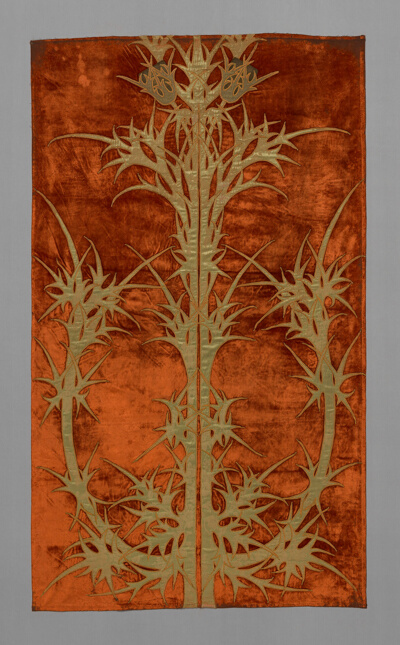
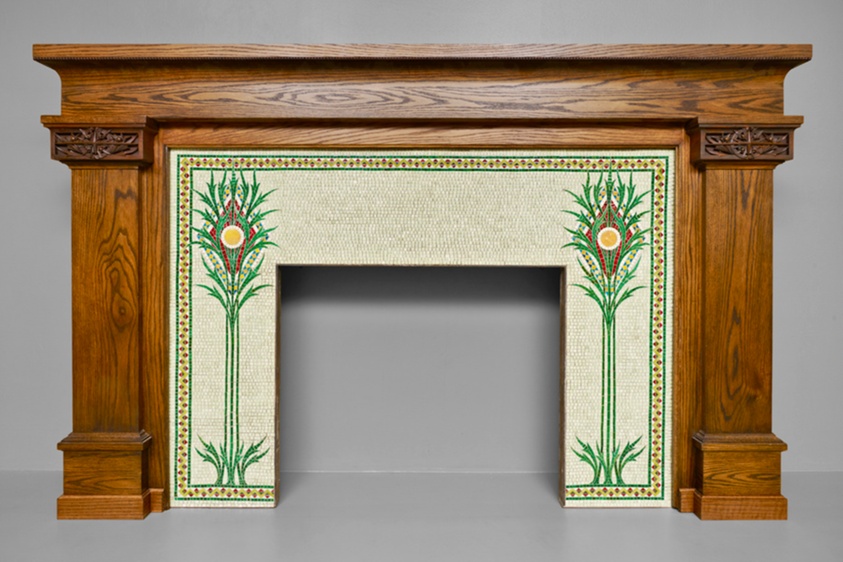
Prairie School architect George Washington Maher worked for Joseph Lyman Silsbee before striking out on his own. During this period Maher developed a system of design that he called the “motif rhythm theory,” in which he created a signature motif to harmonize the interior and exterior of a house through the repetition of decorative details based on local natural forms. He frequently collaborated with Louis J. Millet on his commissions, including the Patrick J. King House (1901), from which this fireplace surround came. This extraordinary object is composed of glass mosaics and features one of Maher’s most prominent motifs, the stylized thistle. It is delicately rendered in shades ranging from pale seafoam green to vibrant greens, blues, and yellows. The fireplace surround is an outstanding example of Millet’s exacting execution of Maher’s designs.
Ask about this work
Ask in your own words. The answer comes from what the museum has written about the work, and says so when that does not hold it.
Details
- Maker
- Designed by George Washington Maher, American, 1864–1926, Made by Louis J. Millet, American, 1855–1923
- Date
- 1901
- Medium
- Oak and glazed earthenware
- Dimensions
- Surround: 130.8 × 209.6 cm (51 1/2 × 82 1/2 in.); Mosaic: 111.8 × 162.6 cm (44 × 64 in.); Opening: 76.2 × 90.2 cm (30 × 35 1/2 in.)
- Place of origin
- United States
- Held by
- Art Institute of Chicago, Chicago · Not on view
- Credit line
- Gift of Alan Wanzenberg in memory of Jed Johnson
Image: Art Institute of Chicago, CC0