Portière
What did you think?
Guide
Adjust the guideNew to it · Medium
Nobody has listened to this guide yet. Making it takes about twenty seconds, and after that anyone can hear it straight away.
From the museum
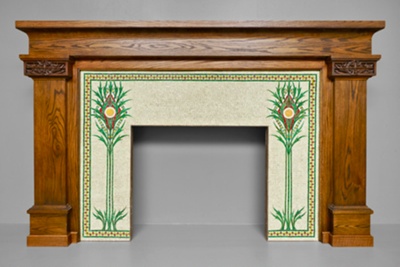
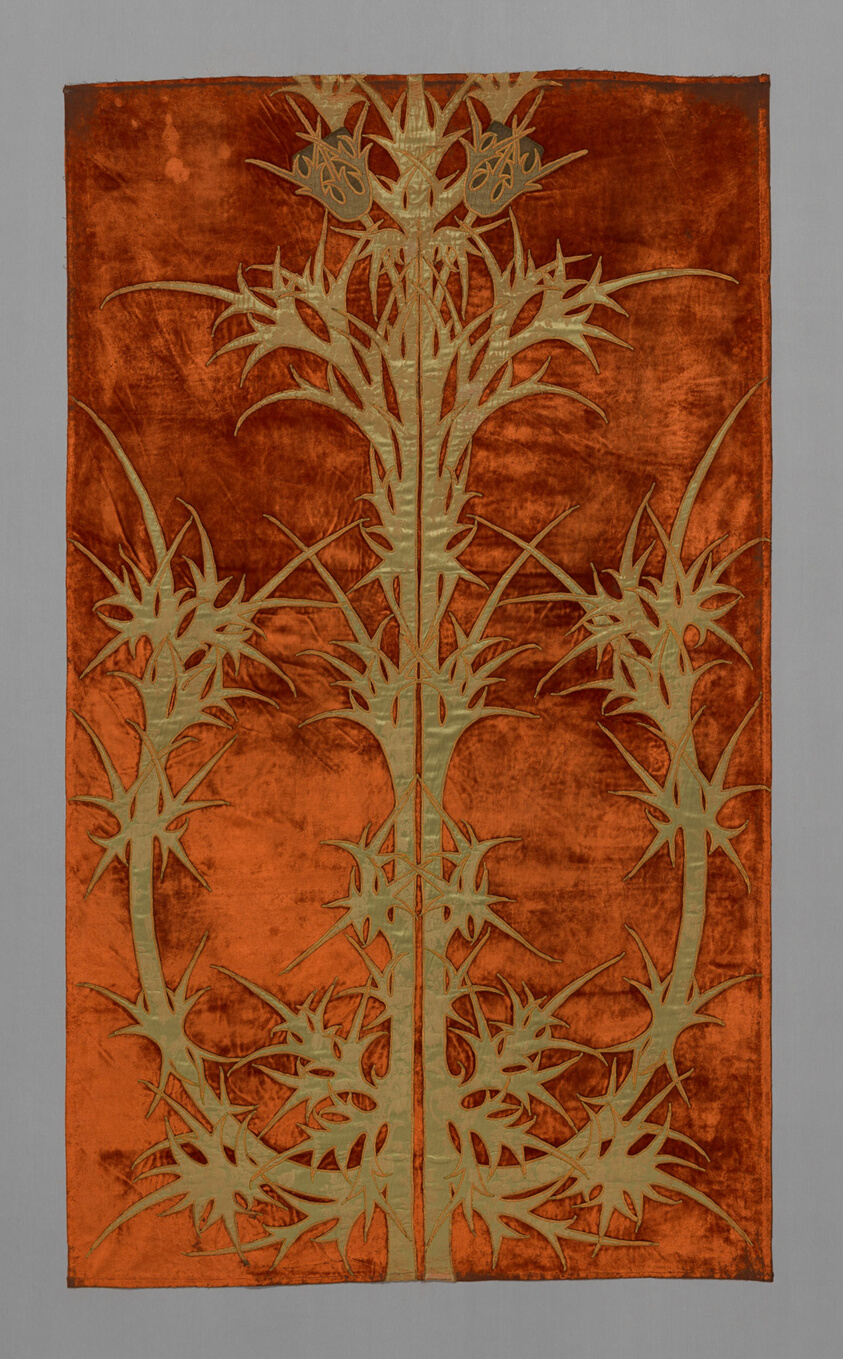
Chicago architect George W. Maher was one of many Americans who embraced the English Arts and Crafts movement, incorporating into his residential designs an emphasis on simplicity, natural forms, and respect for materials. This silk and cotton Portière hung over a doorway in Maher's James A. Patten house in Evanston, Illinois, built in 1901. The highly stylized and linear thistle motif created for this panel and other elements of the Patten house by Maher and designer Louis J. Millet helped achieve the decorative rhythm and unity that Maher believed was essential to the successful design of any residence.
The museum’s own description, in English. Licence: CC BY 4.0
Ask about this work
Ask in your own words. The answer comes from what the museum has written about the work, and says so when that does not hold it.
Details
- Maker
- Designed by George Washington Maher (American, 1864–1926), Possibly produced by Louis J. Millet (American, 1853–1923), Designed and made for the James A. Patten House in Evanston, Illinois
- Date
- 1901
- Medium
- Cotton and silk, plain weave with pile warps forming cut solid velvet; appliquéd with silk and cotton, satin damask weave; linen and gilt-strip-wrapped linen satin weave; cotton and silk plain weaves; embroidered with silk, cotton, linen, and gilt-metal-strip-wrapped linen threads
- Dimensions
- 204.1 × 119 cm (80 3/8 × 46 7/8 in.)
- Place of origin
- United States
- Held by
- Art Institute of Chicago, Chicago · Not on view
- Credit line
- Purchased with funds provided by the Antiquarian Society
Image: Art Institute of Chicago, CC0