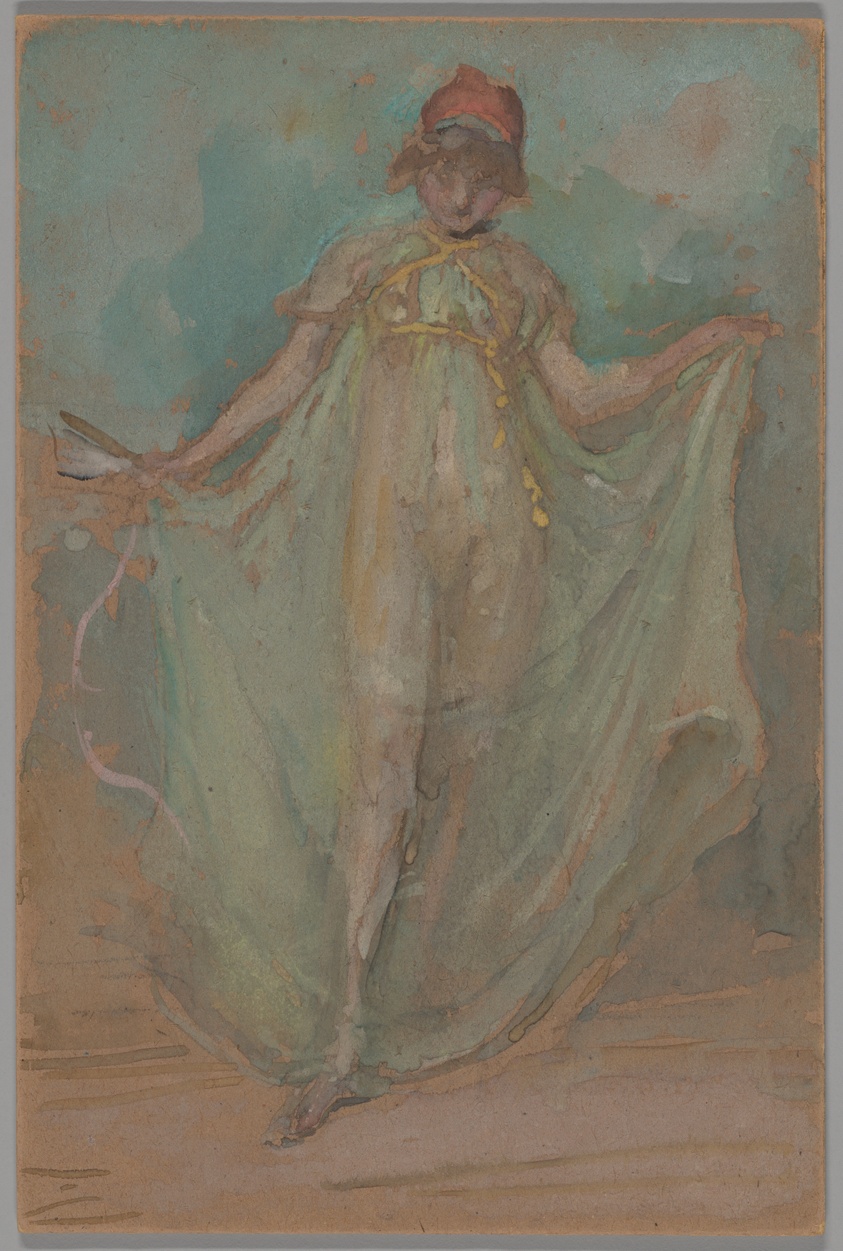
Green and Blue: The Dancer
James McNeill Whistler · c. 1893 · Art Institute of Chicago
What did you think?
Guide
4 chapters · about 2 minAdjust the guideNew to it · Medium
A Dancer in Thin Color
This is a small watercolor, about the size of a sheet of notebook paper, showing a young woman in motion. She wears a light, see-through gown that clings and drifts around her body. The colors named in the title, green and blue, appear in her drapery. The paint is laid on in thin, watery layers, so the figure feels light and quick, as if caught between steps. Behind her there is little more than the warm brown of the paper itself. The work is by James McNeill Whistler, and it dates from around 1893.
Where to Look
Start with the paper. It is brown, and you can see it glowing through the thin washes of paint. A wash is a layer of watercolor thinned with plenty of water. Because the brown shows through, the paint looks a little denser, and the veils of fabric around the figure seem to have a quiet weight. Then follow the drapery down the length of her body and notice how softly it is handled. Finally, look for the faint dark lines of chalk beneath the color, which are traces of the first marks the artist made.
Whistler and His Models
Whistler painted this around 1893, during a decade when he was fascinated by the female figure in flowing, nearly transparent clothing. Greek sculpture and Japanese prints inspired him. He explored the theme in many materials, including lithography, oil, pastel, and watercolor. He usually supplied the gowns himself, often classical ones with a high waist and a crossed bodice, paired with brightly colored kerchiefs. His models had to be strong and agile, because he sometimes asked them to dance around his studio until he found the right pose.
Capturing Movement
Here Whistler used thin washes of watercolor to boil down the graceful movement of his young model into a few light strokes. Rather than recording every fold, he suggests a dance with very little paint. That restraint is what gives the work its charm. Look once more at the figure's gown against the brown ground, and see how much motion he suggests with so little color.
This guide was written by AI from the description published by Art Institute of Chicago. Licence: CC BY 4.0
Ask about this work
Ask in your own words. The answer comes from what the museum has written about the work, and says so when that does not hold it.
Details
- Maker
- James McNeill Whistler, American, 1834-1903
- Date
- c. 1893
- Medium
- Watercolor and opaque watercolor over traces of black chalk on brown wove paper laid down on card
- Dimensions
- 27.5 × 18.3 cm (10 7/8 × 7 1/4 in.)
- Place of origin
- United States
- Held by
- Art Institute of Chicago, Chicago · Not on view
- Credit line
- Purchased with funds provided by Dr. William D. Shorey; through prior acquisitions of the Charles Deering Collection and through prior bequest of Mrs. Gordon Palmer
Image: Art Institute of Chicago, CC0
More by James McNeill Whistler
GuideNocturne: Blue and Gold—Southampton WaterJames McNeill Whistler · 1872
Arrangement in Flesh Color and Brown: Portrait of Arthur Jerome EddyJames McNeill Whistler · 1894
Violet and Silver—The Deep SeaJames McNeill Whistler · 1893
Trouville (Grey and Green, the Silver Sea)James McNeill Whistler · 1865