Mantle
Paracas · 100 BCE-200 CE · Art Institute of Chicago
Guide
Adjust the guideNew to it · Medium
Looking for this guide.
From the museum
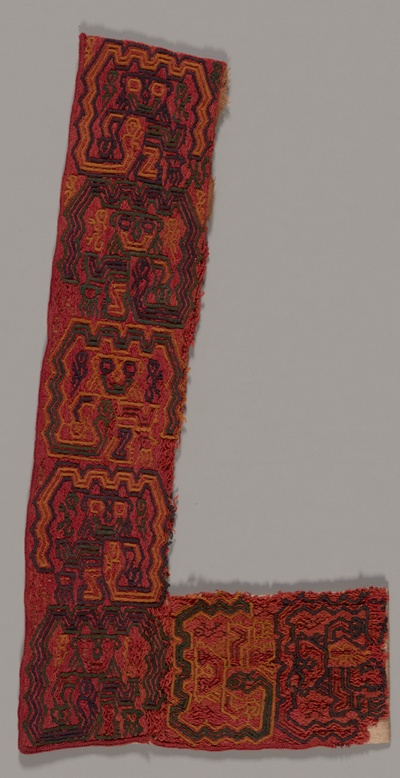
This expansive mantle, designed to be wrapped around the shoulders, features over 50 figures in brightly colored embroidery, a form of embellishment composed of needle-worked stitches. With their heads bent to the side, each figure wears a headdress, ear ornaments, and a tunic with a decorated border, and carries a feline under one arm. The pronounced stripes on the animal’s legs identify it as the pampas cat, a predator known to protect crops. Scroll-like motifs that emerge from the figures’ mouths and upraised hands may mimic the protruding tongues of the cats and signal an effort to embody the supernatural forces that govern the natural world. The Paracas employed a number of textile embellishment techniques, and their embroidery work remains particularly impressive to modern eyes. Although all of the embroidery is done in a single stitch, the medley of colors demonstrates that the Paracas possessed a rigorous understanding of dyeing.
The museum’s own description, in English. Licence: CC BY 4.0
What did you think?
Save this work’s image and museum information on this device to read without a connection.
Ask about this work
Ask in your own words. The answer comes from what the museum has written about the work, and says so when that does not hold it.
Details
- Maker
- Paracas, South coast, Peru
- Date
- 100 BCE-200 CE
- Medium
- Wool (camelid), plain weave; embroidered in stem stitches; corners edged with weft-faced plain weave with extended ground weft fringe and embroidered in cross-knit loop stitches
- Dimensions
- 238.1 × 106.7 cm (93 3/4 × 42 in.)
- Place of origin
- Peru
- Held by
- Art Institute of Chicago, Chicago · Not on view
- Credit line
- Emily Crane Chadbourne Fund
Image: Art Institute of Chicago, CC0