Just a moment
Just a moment
John Singleton Copley · c. 1764 · Art Institute of Chicago
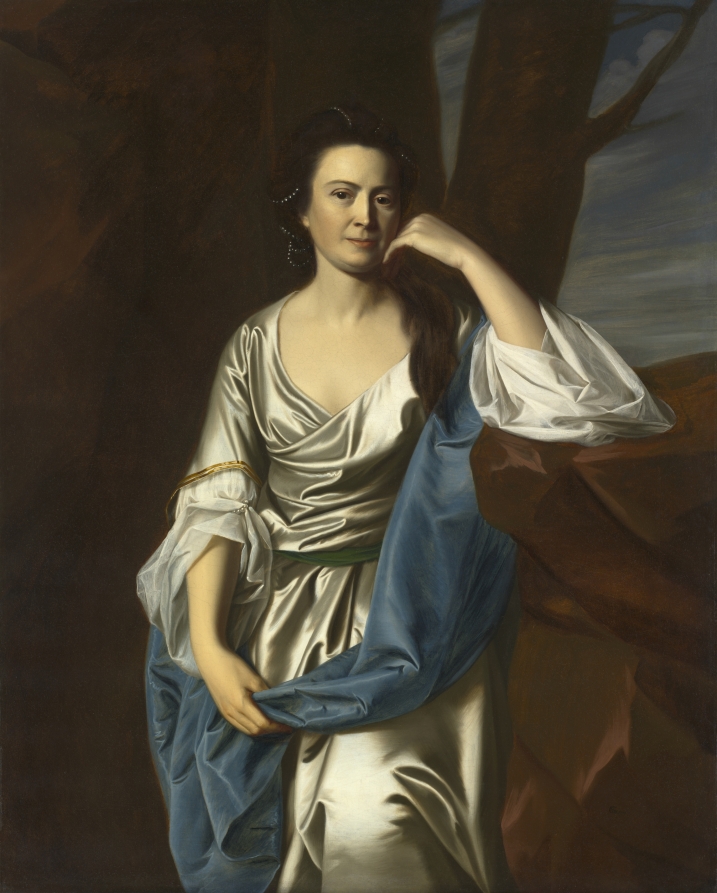
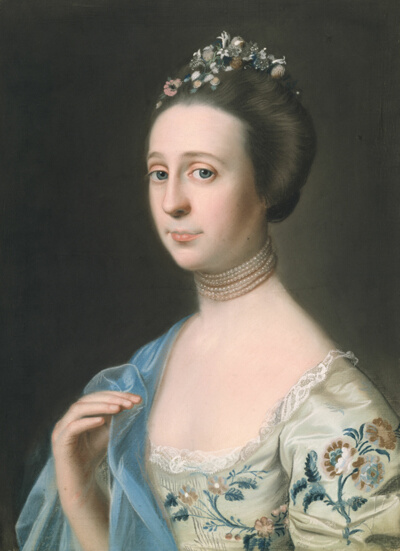
This is a portrait of Mary Greene Hubbard, painted in oil on canvas by John Singleton Copley around 1764. It is a large picture, about four feet tall and a little over three feet wide, so the sitter appears close to life size. She belonged to Boston's merchant class, the business families of the colonial city. The painting shows her in a luxurious gown, set against a background behind her. Her portrait has a partner: Copley also painted her husband, Daniel Hubbard, and that picture is in the same museum in Chicago.
Start with the face. Copley caught Mary Hubbard's own individual features, so she looks like a particular person and not a stock figure. Then let your eye travel down to the gown, which fills much of the canvas. Look at how the painter shows the surface and color of the rich fabrics, the way cloth seems to have weight, sheen and texture. Finally, notice the pose and the setting behind her. They look polished and formal, and as the next part explains, they were not Copley's own invention.
Copley was largely self-taught. His only formal training came from his stepfather, Peter Pelham, an English artist who made mezzotints, a kind of engraving that prints soft tones of light and dark. For this portrait, Copley copied the pose, the gown and the background precisely from a British engraving of a noblewoman. He still made the work his own by painting the sitter's individual features and the surfaces and colors of the fabrics. Despite his lack of training, he became a successful portrait painter before the Revolutionary War.
About ten years after this portrait, Copley left colonial Massachusetts for England. He wanted to advance his career, and he also wanted to escape the sharp political divisions among family, friends and patrons as the Revolution drew near. This picture comes from the busy years before that departure. It shows how a Boston family could borrow the look of English nobility, while the painter added a real person. Look a little longer at the face, and ask how much of Mary Hubbard shows beside the borrowed gown.
This guide was written by AI from material published by Art Institute of Chicago. Licence: CC BY 4.0
Save this version (English · New to it · Medium) with all its audio, guide text and work image. It replaces the saved guide for this work and language.
Audio storage: about 40 MB per guide and 150 MB on this device. Audio expires 7 days after it is downloaded.
Save this work’s image and museum information on this device to read without a connection.
Ask in your own words. The answer comes from what the museum has written about the work, and says so when that does not hold it.
Image: Art Institute of Chicago, CC0