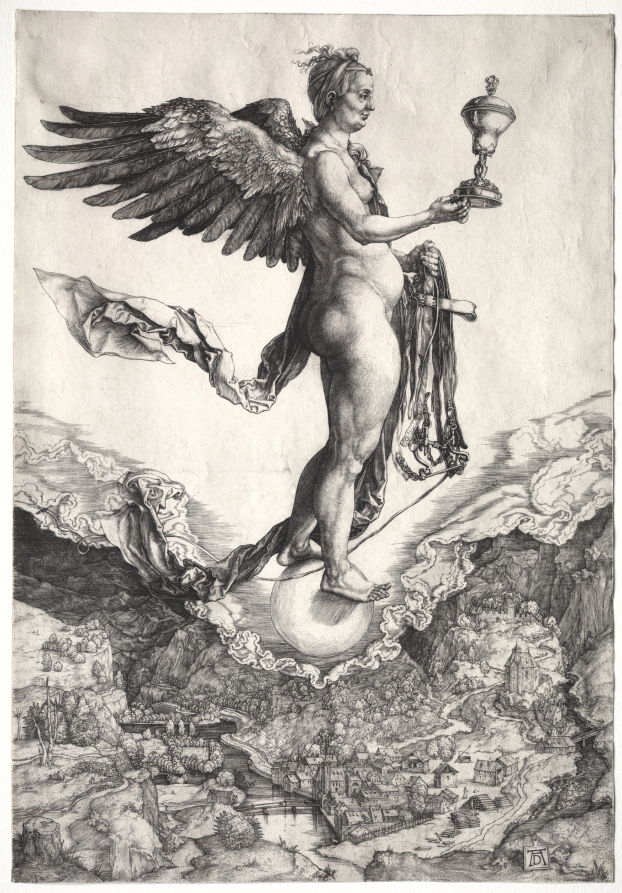
Nemesis
Albrecht Dürer · c. 1501–02 · Cleveland Museum of Art
What did you think?
Guide
Adjust the guideNew to it · Medium
Nobody has listened to this guide yet. Making it takes about twenty seconds, and after that anyone can hear it straight away.
From the museum
Martin Schongauer’s painterly sense of light and composition influenced Albrecht Dürer. The younger Dürer even visited Schongauer but arrived after his death. Nemesis, based on a Latin poem by Italian scholar Angelo Poliziano (1454–1494), is the Greek goddess of moral judgment and justice; her goblet and bridle symbolize reward and punishment. The print showcases Dürer’s organized, graphic approach to engraving, with refined dark-to-light transitions that create an unprecedented three-dimensional effect. His varied marks—from long and winding to crossed and dotted—produce organized and finely detailed vignettes. Such large, elaborate engravings took Dürer months to complete and attracted a growing number of collectors.
The museum’s own description, in English. Licence: CC0
Ask about this work
Ask in your own words. The answer comes from what the museum has written about the work, and says so when that does not hold it.
Details
- Maker
- Albrecht Dürer (German, 1471–1528)
- Date
- c. 1501–02
- Medium
- engraving
- Dimensions
- Sheet: 33.3 x 23 cm (13 1/8 x 9 1/16 in.)
- Place of origin
- Germany
- Held by
- Cleveland Museum of Art, Cleveland · Not on view
- Credit line
- Gift of Mrs. Ralph King
Image: Cleveland Museum of Art, CC0
More by Albrecht Dürer


Shown in
- The Renaissance Engraver at WorkJul 5, 2026 – Nov 1, 2026
- Gods and Heroes: Ancient Legends in Renaissance ArtAug 26, 2017 – Dec 31, 2017
- Dürer's Women: Images of Devotion and DesireJun 22, 2014 – Sep 28, 2014
- Albrecht Dürer and His InfluenceJan 16, 1991 – Mar 10, 1991
- Old Master Prints and DrawingsJul 29, 1966 – Feb 28, 1967