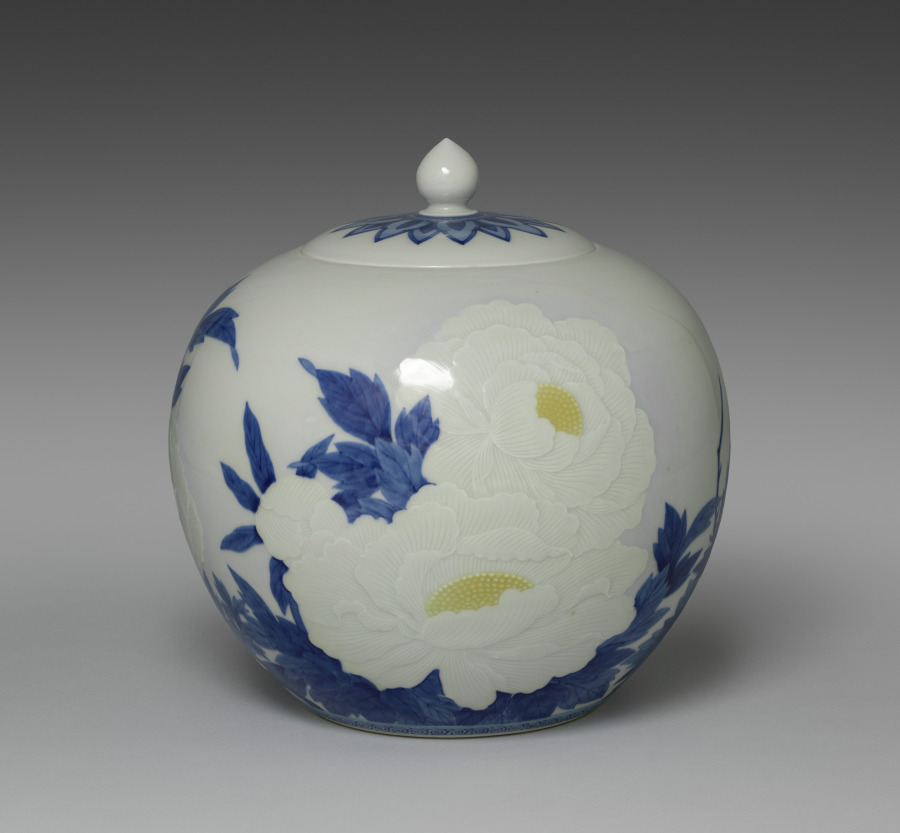
Pheasants in Cherry
Seifu Yohei III · 1900–1914 · Cleveland Museum of Art
Guide
Adjust the guideNew to it · Medium
Nobody has listened to this guide yet. Making it takes about twenty seconds, and after that anyone can hear it straight away.
From the museum
Like the design of Flower Vase with Phoenix in Paulownia (CMA 2022.199), the pair of pheasants in a dramatic landscape setting on this vase was created by adding clay to the surface of the clay body and then molding and carving it. Here, instead of a typical white clay, Yohei III has used an ivory clay. He then added gradated pink around the complex design, which with its multitude of cherry blossoms must have been painstaking to mask with precision. For the birds’ eyes, he added a touch of yellow. He then fired the vase with an allover translucent cream glaze. The resulting kanpakuji piece is one in which an academic subject long favored by painters of the Kano school for screen and sliding door paintings in important buildings, that of impressively sized birds within a scene of precipitous, angled rock faces and twisting trees, is made soft and ethereal while retaining a sense of gravitas. The unusually large scale of this piece and the fact that he signed the base “Made by Seifū of Great Japan” also suggest that it was made for public display.
The museum’s own description, in English. Licence: CC0
What did you think?
Save this work’s image and museum information on this device to read without a connection.
Ask about this work
Ask in your own words. The answer comes from what the museum has written about the work, and says so when that does not hold it.
Details
- Maker
- Seifū Yohei III (Japanese, 1851–1914)
- Date
- 1900–1914
- Medium
- Porcelain with molded and carved design, underglaze color, and cream glaze
- Dimensions
- height: 39 cm (15 3/8 in.); Diameter: 28.5 cm (11 1/4 in.)
- Place of origin
- Japan
- Held by
- Cleveland Museum of Art, Cleveland · Not on view
- Credit line
- Dudley P. Allen Fund
Image: Cleveland Museum of Art, CC0