Prout's Neck, Breakers
Winslow Homer · 1883 · Art Institute of Chicago
Guide
Adjust the guideNew to it · Medium
Nobody has listened to this guide yet. Making it takes about twenty seconds, and after that anyone can hear it straight away.
From the museum
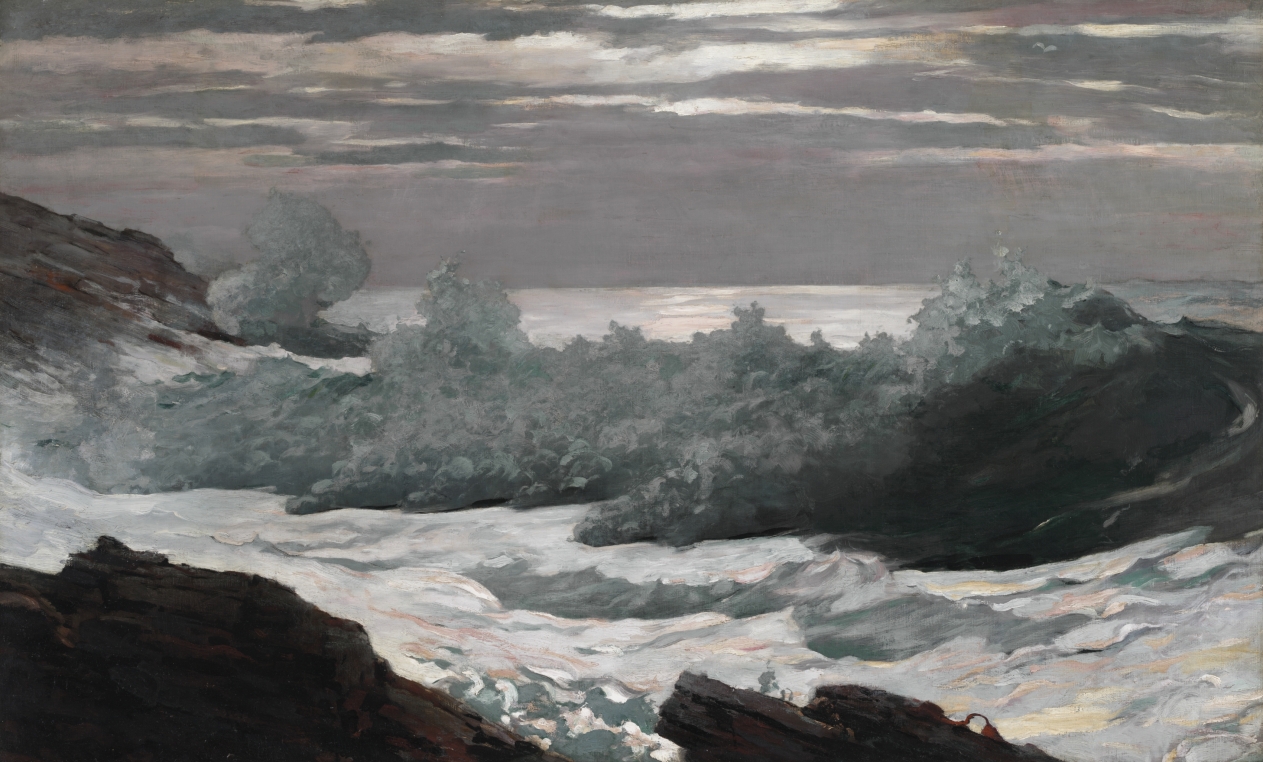
Homer’s decision to move to Maine in 1883 presumably indicated his desire to live close to nature—Prout’s Neck was a peninsula known for its rocky coastline and dramatic views of the Atlantic Ocean. Prout’s Neck, Breakers, later the model for the monumental oil painting Early Morning after a Storm at Sea, shows the artist’s continued fascination with the power of the sea. However, unlike his earlier marine works, this and other watercolors made at Prout’s Neck are usually devoid of human activity, exploring nature’s grandeur in its many manifestations. This work also exemplifies important aspects of Homer’s technique as a watercolorist, including the way he layered strokes of color—using a range of light and dark blues—to create the depth and force of the breaking waves. He used the white of the paper to produce a brilliant sheen on the sea, juxtaposed with a hazy sky above.
The museum’s own description, in English. Licence: CC BY 4.0
What did you think?
Save this work’s image and museum information on this device to read without a connection.
Ask about this work
Ask in your own words. The answer comes from what the museum has written about the work, and says so when that does not hold it.
Details
- Maker
- Winslow Homer, American, 1836-1910
- Date
- 1883
- Medium
- Watercolor, with blotting and sanding, over charcoal, on moderately thick, moderately textured, ivory wove paper
- Dimensions
- 38.1 × 54.6 cm (15 × 21 1/2 in.)
- Place of origin
- United States
- Held by
- Art Institute of Chicago, Chicago · Not on view
- Credit line
- Mr. and Mrs. Martin A. Ryerson Collection
Image: Art Institute of Chicago, CC0